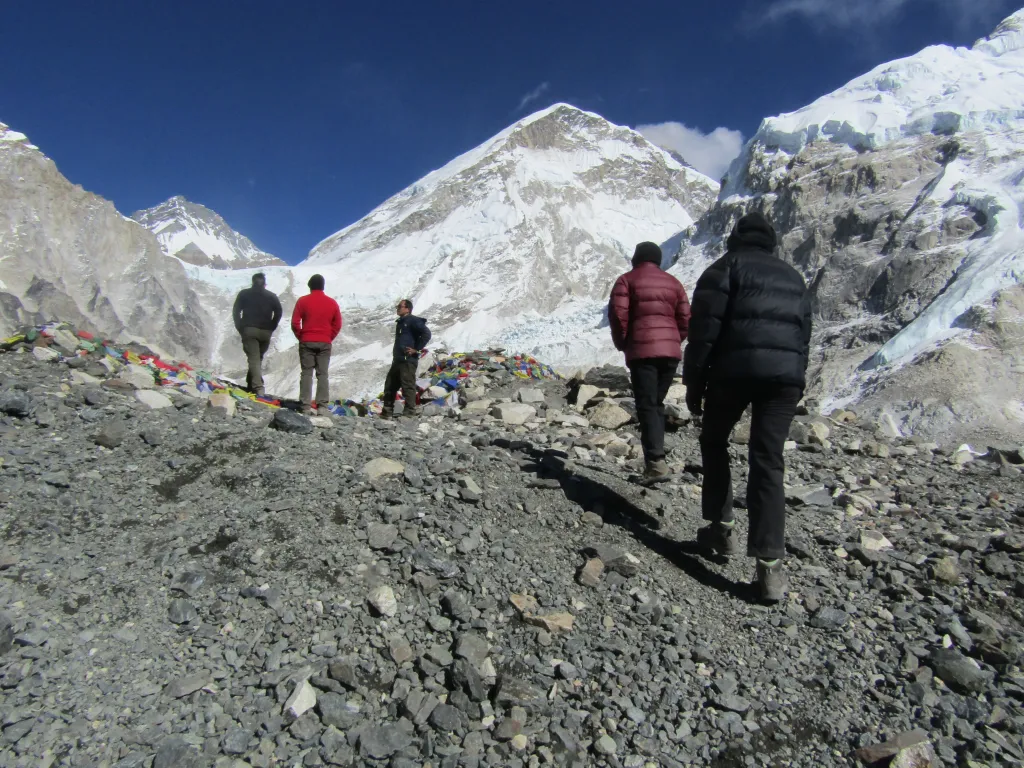
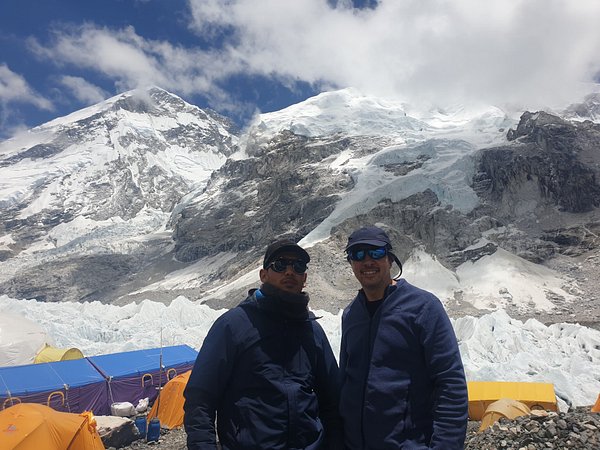
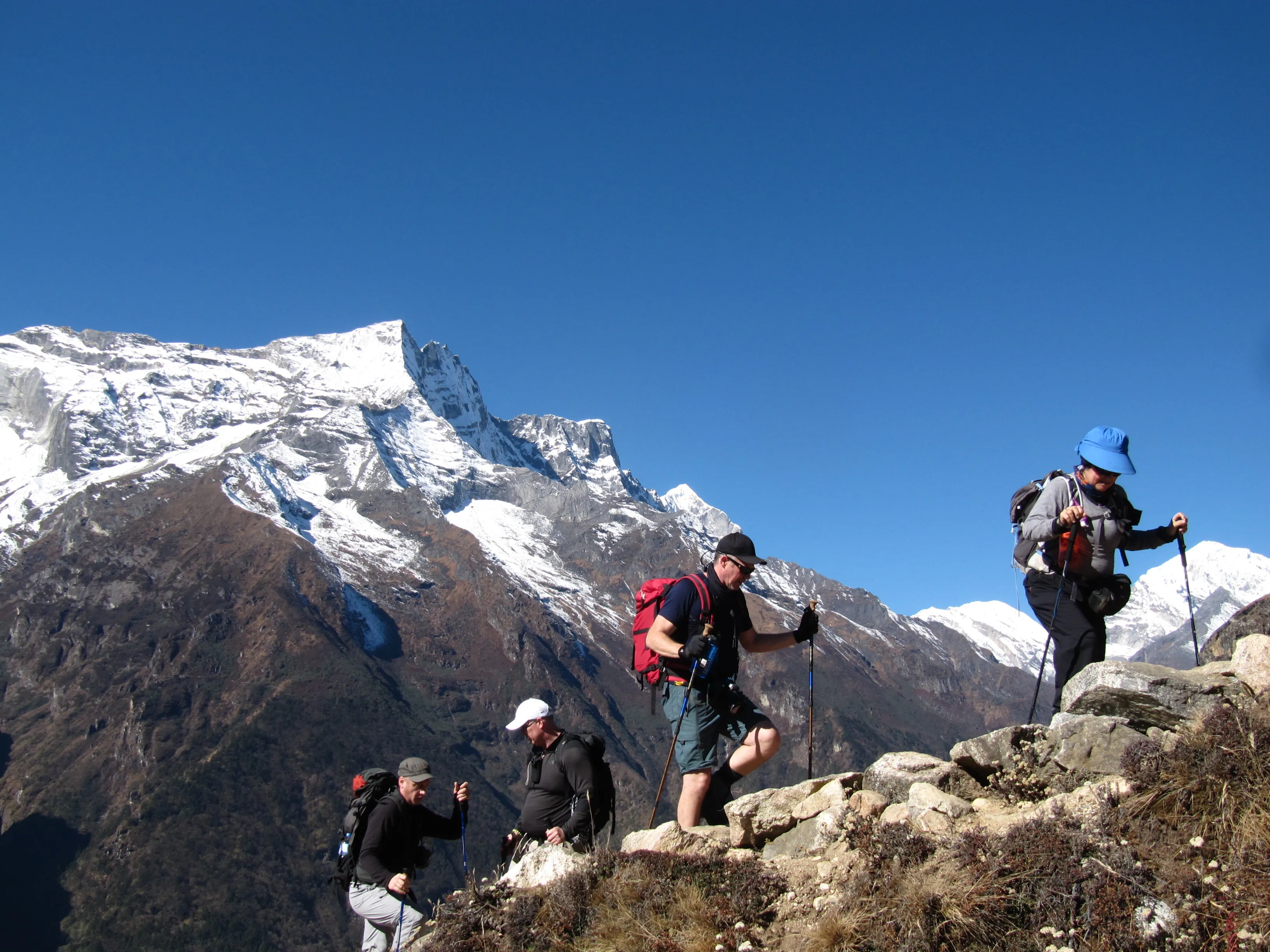
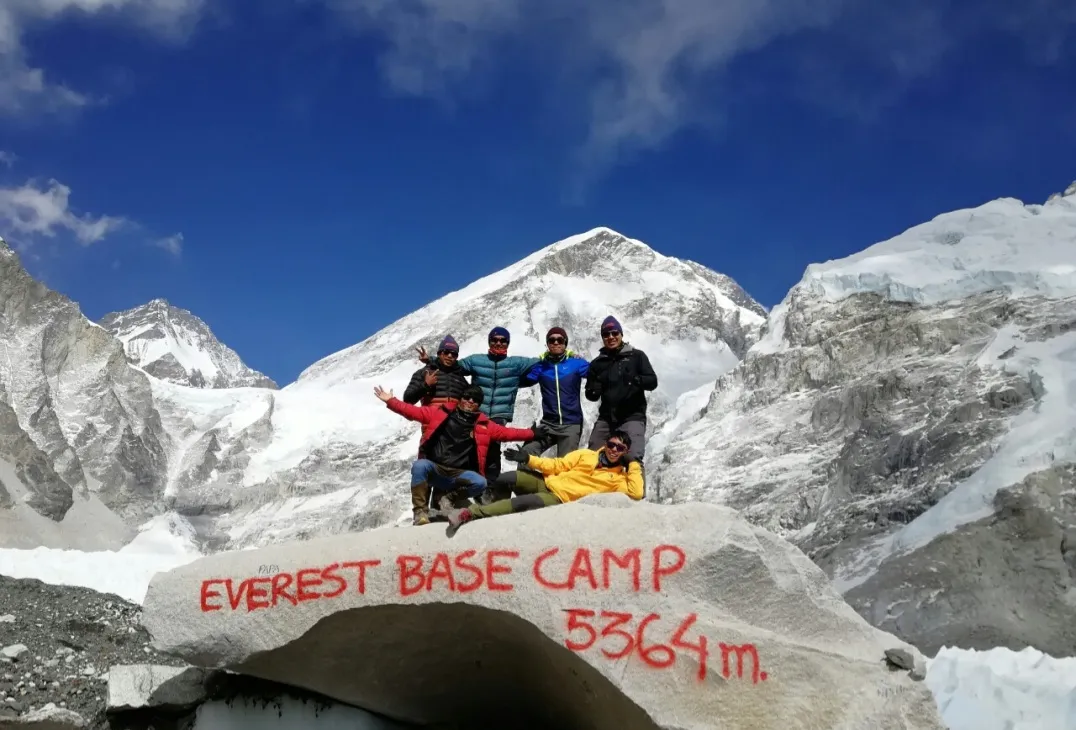
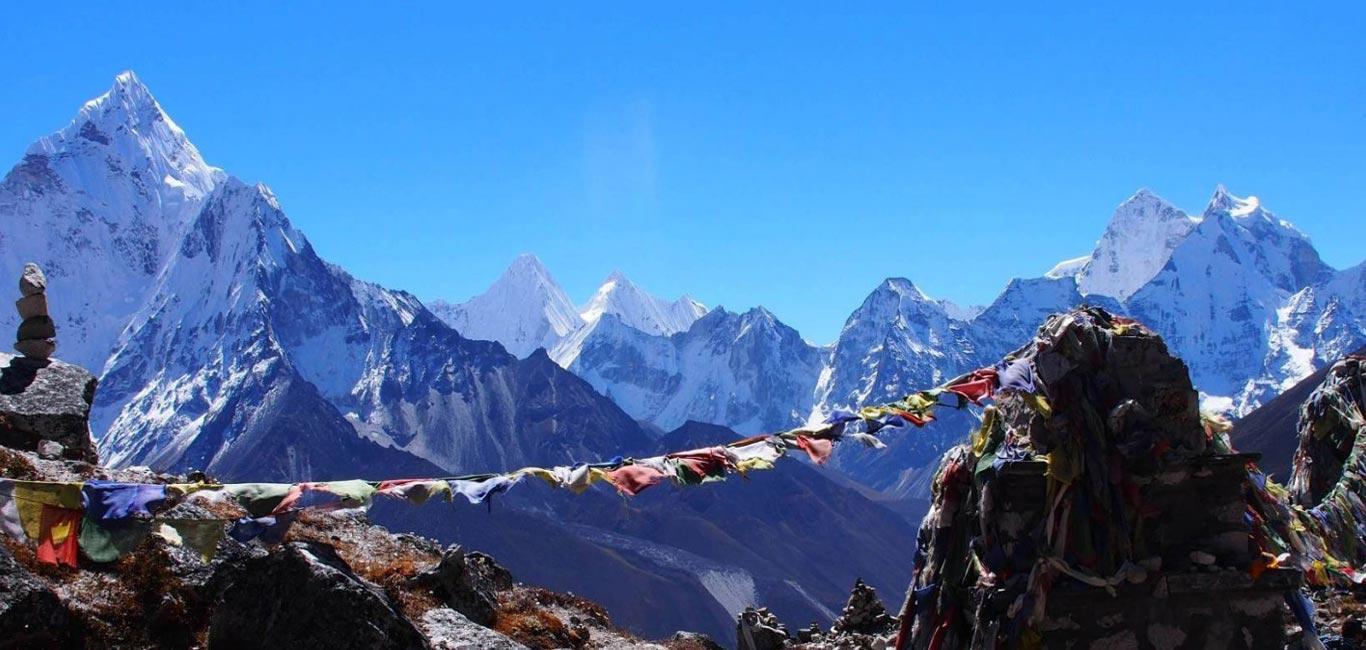
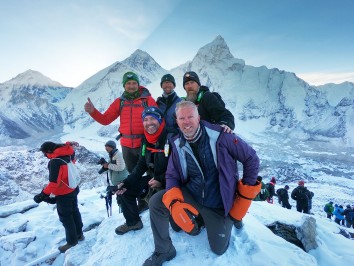
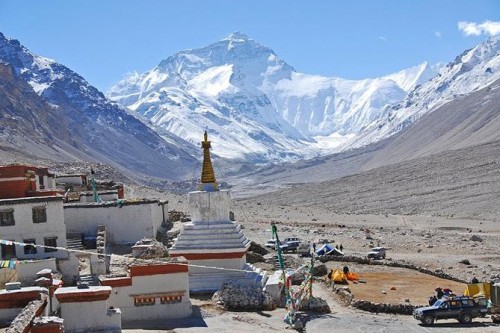
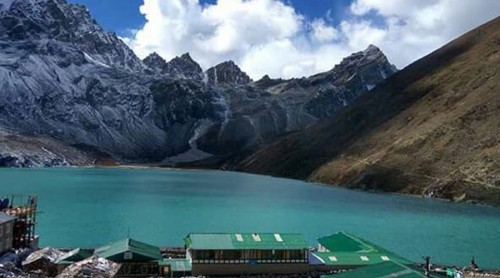
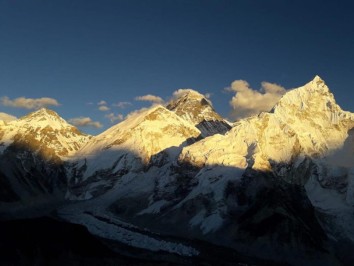
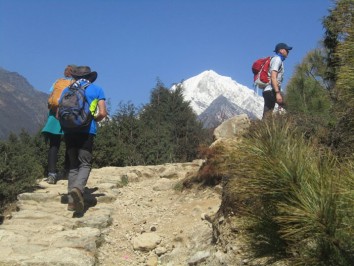
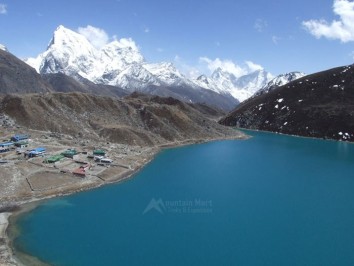
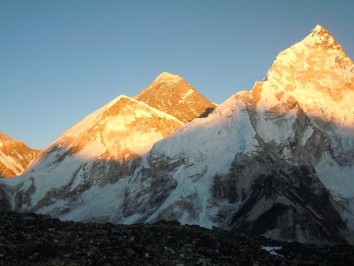
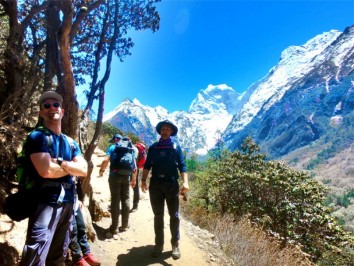
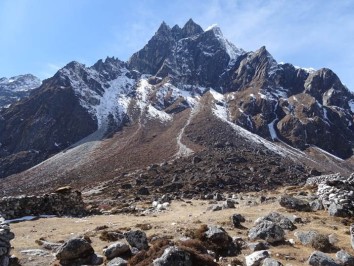
The Everest Three High Pass Trek is one of Nepal’s most challenging and rewarding high-altitude adventures, designed for experienced trekkers seeking a true Himalayan test. This epic journey crosses the three legendary passes—Kongma La, Cho La, and Renjo La—while exploring the heart of the Everest region. Trekkers enjoy breathtaking views of Mount Everest, Lhotse, Makalu, Cho Oyu, and Ama Dablam, along with visits to Everest Base Camp, Kala Patthar, and the stunning Gokyo Lakes. Ideal for adventure lovers, this trek combines dramatic landscapes, Sherpa culture, and unmatched mountain panoramas for a once-in-a-lifetime experience.
The Everest three pass trek links Everest Base Camp and Gokyo Lake trek with two additional trails to the east and west of this central region. It includes three the Everest high passes as each over 5,300m plus the possibility of poor weather conditions, requires thorough acclimatization and slow and steady ascents that makes the three long and demanding trekking days. This 3 high passes trek in Everest can be tackled in a clockwise or, less-demanding, anticlockwise direction.
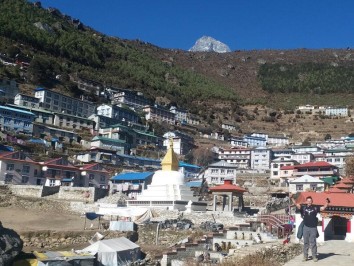
From Lukla, trek to Namche Bazaar for a rest and acclimatization day; visit the Sherpa village of Khumjung. The eastern arm adds a trek up to Chhukhung for two acclimatization nights and add a walk to Chhukhung Ri or to the Island Peak Base Camp for views over and beyond the Lhotse and Ama Dablam glaciers. The locals and National park hotel has managed good Trekkers lodge (Tea-house). You will also find a good camping site to camp in the natural surroundings.
Then conquer the Kongma La (5535m), en-route to Lobuche and Everest Base Camp. Return to Duglha and take the long route up the Cho La (5368m) and steep descent to Thangnak. Cross the Ngozumpa Glacier and head for Gokyo: and a rest day to climb Gokyo Ri for superb views of Nepal’s longest glacier of Cho Oyo and the Everest range.
The western section includes the steep ascent to the Renjo La, some four hours above the lake for stupendous views of the valley and glacier below and numerous high ridges crowned by the Everest Group including the northwest face of Everest. The descent to Marulung faces new dramatic landscapes. Below this village, the trail joins an old Tibetan salt trade route and continues to Thame and then back to Namche Bazaar; and on to Lukla for your flight back to Kathmandu.
| Accomodation: | 3 star hotel (twin room) with breakfast |
| Meals: | Breakfast, |
Our Mountain Mart Trekking Company Airport Representative will meet you outside the Terminal Hall. Please, look for our Treks and Expeditions play card. Transfer to hotel, introduce your trekking guide and check the necessities. Afternoon stroll Tourist colourful market Thamel down town.
| Accomodation: | 3 star hotel (twin room) with breakfast |
| Meals: | Breakfast, |
After breakfast, proceed for sightseeing tours to world heritage sites of Pashupatinath Temple-the holiest Hindu Temple on the bank of sacred Bagmati River, Bodhanath Stupa-the biggest Buddhist Stupa architecture in the world! Patan Durbar Square is the oldest city in the Kathmandu valley with age old tradition also called Lalitpur-the city of fine arts. The visit covers the Durbar Square, the Krishna temple, the Kumbheswore temple, the Golden temple and many more. Swayambhunath Stupa-the 2000 years old legendary stupa on the hillock also nick-named as monkey temple. Your day tour ends Kathmandu Durbar Square Showcasing living goddess Kumari Temple, Nautale Durbar, the Kaal Bhairav, the Swet Bhairav, the freak Street and more.
| Accomodation: | Lodge (Twins Room) |
| Activity Duration: | 35 minutes airstrip and 8km, 3 |
| Meals: | Breakfast, Lunch, Dinner |
Transfer to domestic airport and fly to Lukla (2780m /9175ft) gateway to Everest Base Camp 35 minutes Trans Himalaya flight. Culminate dramatic landing on a hillside Lukla, introduce porters and downhill to beautiful Sherpa settlement Choplung. The trail continues along the side of the Dudh Koshi valley before ascending to Ghat ((2530m /8350ft) Trail climbs gently again about an hour to final destination Phakding.
| Accomodation: | Lodge (Twins Room) |
| Activity Duration: | 11km, 6-7 hrs. |
| Meals: | Breakfast, Lunch, Dinner |
Trek leads through a beautiful pine forest, along Dudh Koshi River crossing many suspension bridges via Sherpa villages Benkar, Chimoa, Monjo and Jorsole. National Park permit check point with the tranquility view of glistering Mt. Thamserku (6618 m) Trail continues through the Dudh Koshi riverbed to the confluence of Bhote Koshi and Dudh Koshi rivers. Trail climbs steadily crossing high Tenzing- Hilary suspension bridge. On the way inspiring glimpse of Mt. Everest right up next Nuptse- Lhotse ridge. About 3 hours ascend through the wonderful pine forest finally reach a prosperous trading and administrative village Namche Bazar.
| Accomodation: | Lodge (Twins Room) |
| Activity Duration: | 4km, 4-5hrs. |
| Meals: | Breakfast, Lunch, Dinner |
It’s a scheduled acclimatization day of the trek. Acute Mountain Sickness (AMS) and health experts recommend to hold at least one extra night. Stay active and roaming instead of being lazy. Namche Bazar has ATMs, cyber cafés, finger licking delicious restaurants, bakery, colorful market each Friday evening and Saturday morning. There is day trip starts visiting Sagarmatha (Everest) National park visitor centre on the hillock where we can observe an assortment of things related to the first Everest ascenders, Sherpa culture and learn about the various plants and animal life of the Everest region. Then take entertaining acclimatization side trip to large traditional Sherpa village Khumjung with the view of Thamserku, Khaantaiga, Ama Dablam, Mt, Everest and many more.
| Accomodation: | Lodge (Twins Room) |
| Activity Duration: | 9km, 6-7hrs. |
| Meals: | Breakfast, Lunch, Dinner |
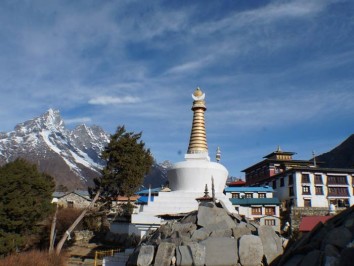
The trail leads moderately flat with superb view of Mt. Everest, Nuptse, Lhotse, Ama Dablam and close up view of Thamserku, Khangtaiga. The trail continues wild lives spot of musk deer (a herd of Himalayan Thar) colorful pheasant (Danphe, National bird) Trail descend to Dudh Koshi river where few lodges and series of picturesque water driven prayer wheels. Cross suspension bridge over Dudh Koshi River a steep climb through pine and juniper forest, walk about 2 hours bring you to Tenboche. The famous Gomba (Tengboche Monastery) with the background of Ama Dablam, Nupte, Mt. Everest and many more peaks. During October/November in full moon the colorful Mani Rimdu festival is held here with masked dancing and Tibetan opera in the monastery courtyard.
| Accomodation: | Lodge (Twins Room) |
| Activity Duration: | 8km, 6-7 hrs. |
| Meals: | Breakfast, Lunch, Dinner |
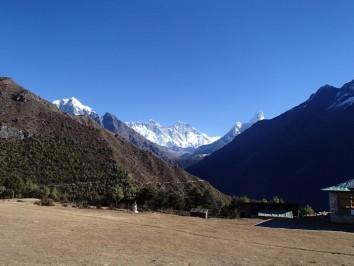
The trail descend to Deboche a small village with Chortens and Mani stone walls and nun monastery. Cross suspension bridge over Imja Khola (Imja Strasm) and gradually ascend to Pangboche with the towering view of Ama Dablam (most beautiful mountain in Everest region) Trail follows upstream closer to Imja River fairly moderate up toward Imja valley. The trail fairly seen open to the confluence of Lobuche river and begin last part of the day to Dingboche the last Sherpa settlement with the beautiful terraced field enclosed by stone wall to avoid barley, buckwheat and potatoes from the cold wind and grazing animals.
| Accomodation: | Lodge (Twins Room) |
| Activity Duration: | 4km, 3-4 hrs. |
| Meals: | Breakfast, Lunch, Dinner |
The walk is pleasant as we leave Dingboche, through stone walled fields and alpine landscape. The views are stupendous as we trek to head of Imja valley. While walking through the valley, Lhotse towers on our left and Ama Dablam on our right. After walking about 3 km, we reach at yak herdsman’s place called Bibre at 4570m. Straight ahead, beyond a terminal moraine wall, soars the Island peak (Imja Tse, 6189m), a most popular trekking peak. The pyramidal Imja Tse looks awesome with its step rock and-icy south face. The trail ahead is intersected by icy streams. About 30 min. walk from Bibre finally, we arrive Chhukung. After Lunch, We might take an opportunity to hike to the rocky knoll of Chhukung Ri at 5546m, which offers stunning views of Lhotse, Island Peak, Ama Dablam, Makalu and several others including Baruntse.
| Accomodation: | Lodge (Twins Room) |
| Meals: | Breakfast, Lunch, Dinner |
A scheduled second rest day for better acclimatization in Chhukung is strongly recommended before setting off for the pass. However, we are not supposed to stay inactive. The view from Chhukung and further up the valley on the moraines towards Island Peak (6189 m) are tremendous. We grasp this opportunity to climb to the Island Peak base camp (4970 m) along the Lhotse glacier, passing the bloated water of Imja Lake. The great south face of Lhotse towers above to the north, while Amphu Lapcha a (5845 m pass) and the immense fluted ice walls that flank it dominate the horizon to the south. To the southwest, the eastern face, of Ama Dablam provides an unusual view of this picturesque peak.
| Accomodation: | Lodge (Twins Room) |
| Activity Duration: | 13km, 9-10hrs. |
| Meals: | Breakfast, Lunch, Dinner |
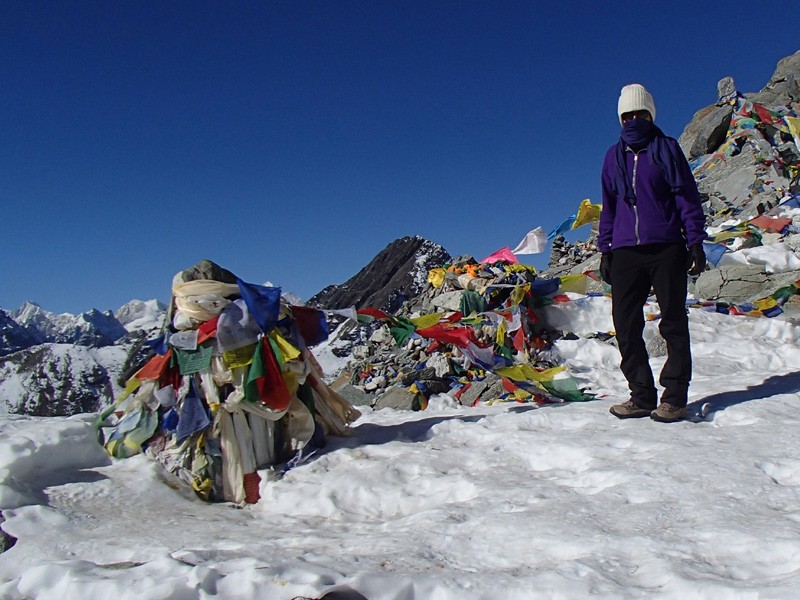
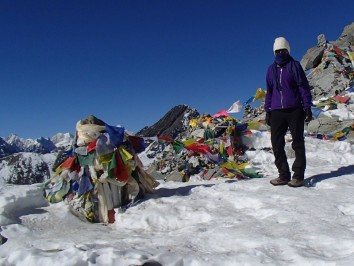
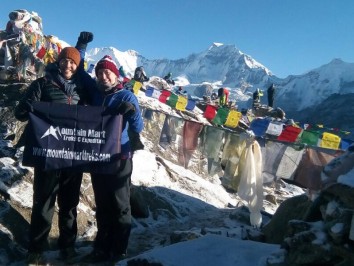
We start at first light from Chhukung, as we have to conquest highest pass of the trip today. We carry plenty of water and some snacks and a packed lunch as there is no Lodges on the way. We really enjoy the remoteness of the area and absolute nature. We can select to go via any of the possible trails- either taking a climb over the hill northwest of Chhukung over the moraine of the Nuptse Glacier or we might walk back down the valley to Bibre and follow a high trail above the Niyang Khola. Just after some walk there are great views of Island peak valley and jagged ridge of Amphu Lapcha. Ascending along the east side of Niyang Khola valley, we turn west and walk through the sloppy stony trial. We enter a wide basin dotted with small frozen lakes. The trail rises over loose scree gaining the Kongma La after about five hours we leave Chhukung. Upon reaching the top, we seen cairn wrapped in prayer flags,-marks of the pass. Behind us is the landscape of icy lakes ahead down of which is the Khumbu Glacier. The final descent is the most difficult stage of the trek today, upon climbing the moraine on the far side, the trail turns north through Khumbu Glacier which takes us to Lobuche.
| Accomodation: | Lodge (Twins Room) |
| Activity Duration: | 14km, 8-9 |
| Meals: | Breakfast, Lunch, Dinner |
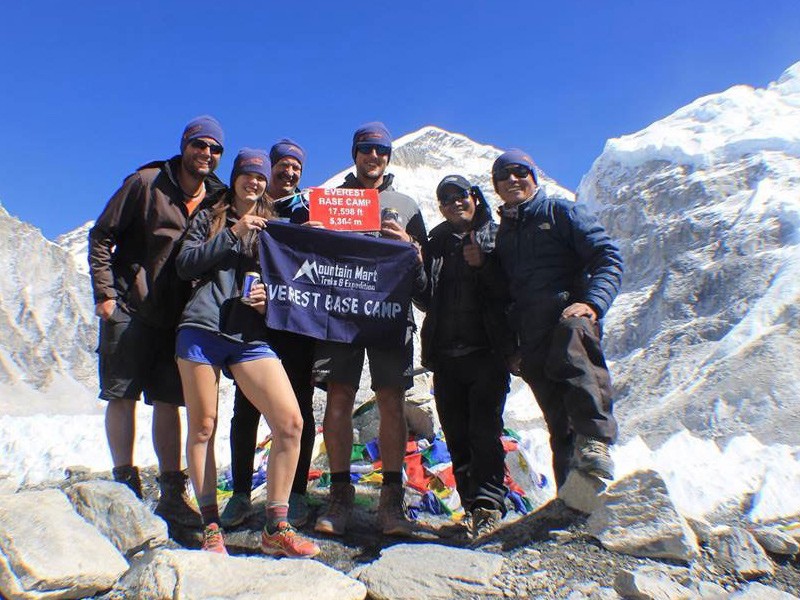
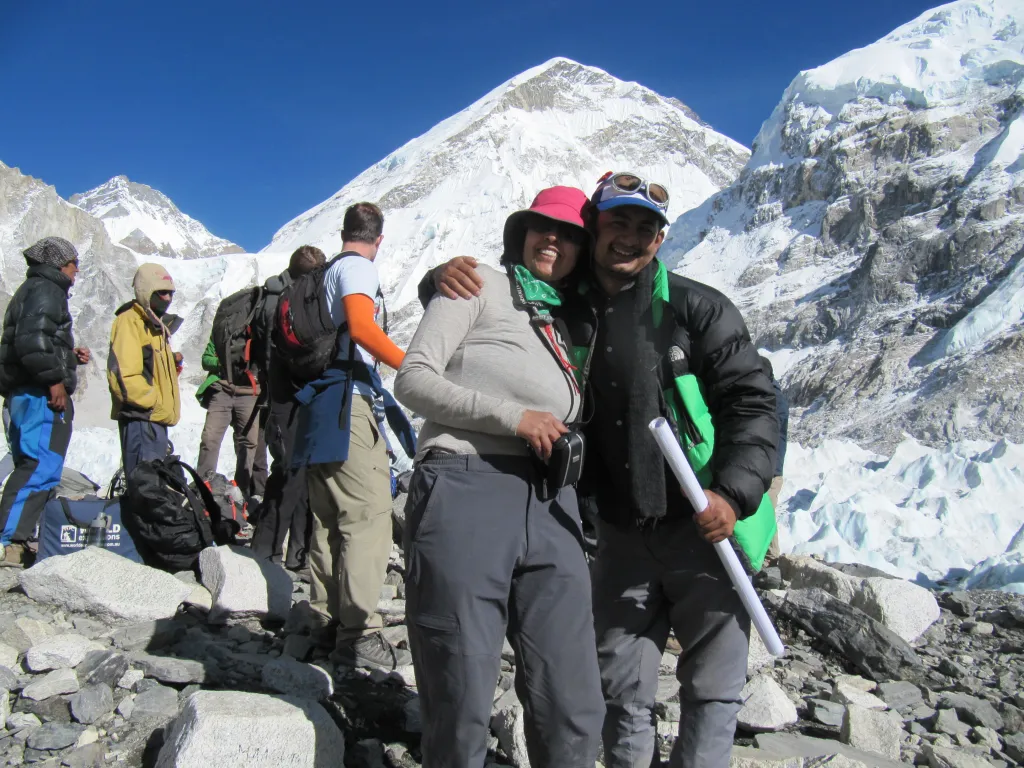
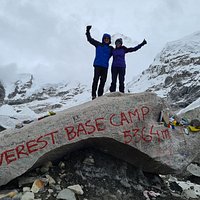
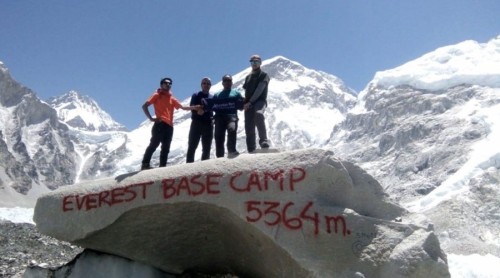
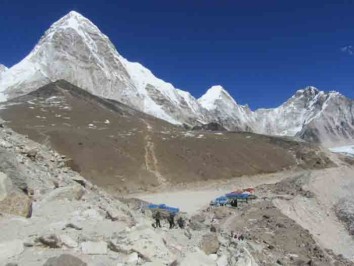
The trail follows windy and rocky path with crest of north ridge to Everest along with Mt. Pumori, Mahalangur, Lingtern, Khumbutse, Nuptse, etc. Trail continues along side of Khumbu Glacier to Gorakshep. Check in to Hotel, Lunch and afternoon set out to visit world’s highest base camp Everest Base Camp. Base Camp has no view of Mt. Everest but fantastic view of Khumbu Icefall and colorful camp site of Everest expedition during expedition season.
| Accomodation: | Lodge (Twins Room) |
| Activity Duration: | 13km, 7-8 hrs. |
| Meals: | Breakfast, Lunch, Dinner |
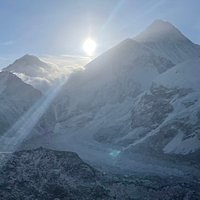
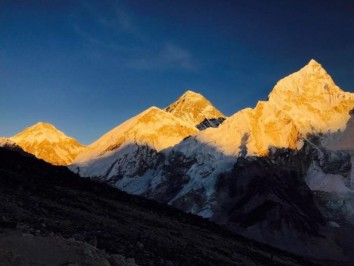
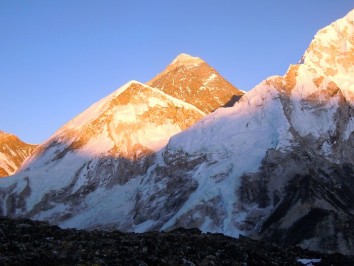
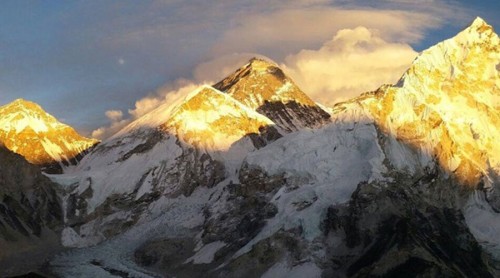
The trail climbs 2/3 hrs. up to Kala Patthar (5,550 m/18,207 ft) early in the morning to see first day sun light from top of the world (Mt. Everest) This is milestone of the trek to inspect panoramic view with the fantastic sunrise over Mt. Everest, Mt. Pumori, Mt. Lingtren, Khumbutse, Changtse, Mt. Lhotse, Mt. Nupte, Mt. Ama Dablam and many more After accomplish Kala Patthar, trek down to Gorakshep and retrace down to Lobuche. After Lunch, the path to Dzonglha branches off from the main trail some distance from Lobuche. After crossing a stream we come through a fork and later curving round to the wide gravelly river bed of the stream as it flows southwestward, the trail runs across it and climbs the ridge ahead. From the grassy ridge ahead, as the trail runs across to southeast from where we can see soaring heights of Ama Dablam and Kangtega-Thamserku while Tawache looms prominently ahead. Pheriche village is also visible down in the valley floor. As the ridge veers northward, the vast Cho La Lake spreads below Mt. Cholatse . The lake stays with us over a long stretch until we descend to a wide basin. The trail climbs up a spur and descends steeply to another broad basin. After an hour walk transverse from the basin and shortly after crossing a wobbly bridge, we reach Dzonglha.
| Accomodation: | Lodge (Twins Room) |
| Activity Duration: | 13km, 9-10 hrs. |
| Meals: | Breakfast, Lunch, Dinner |
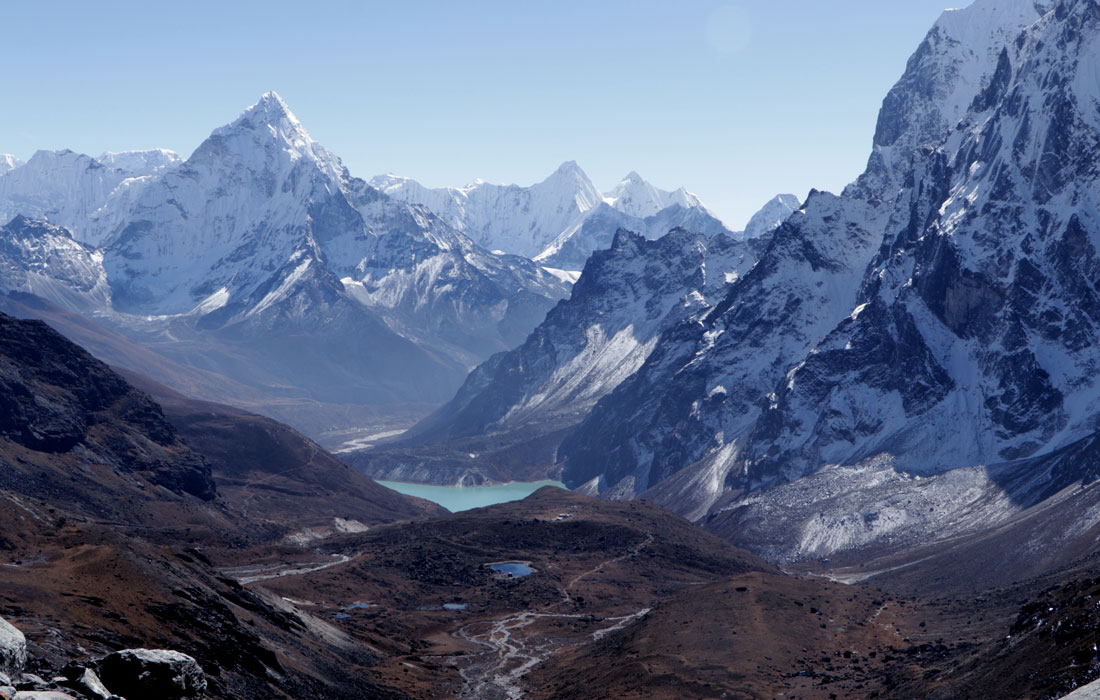
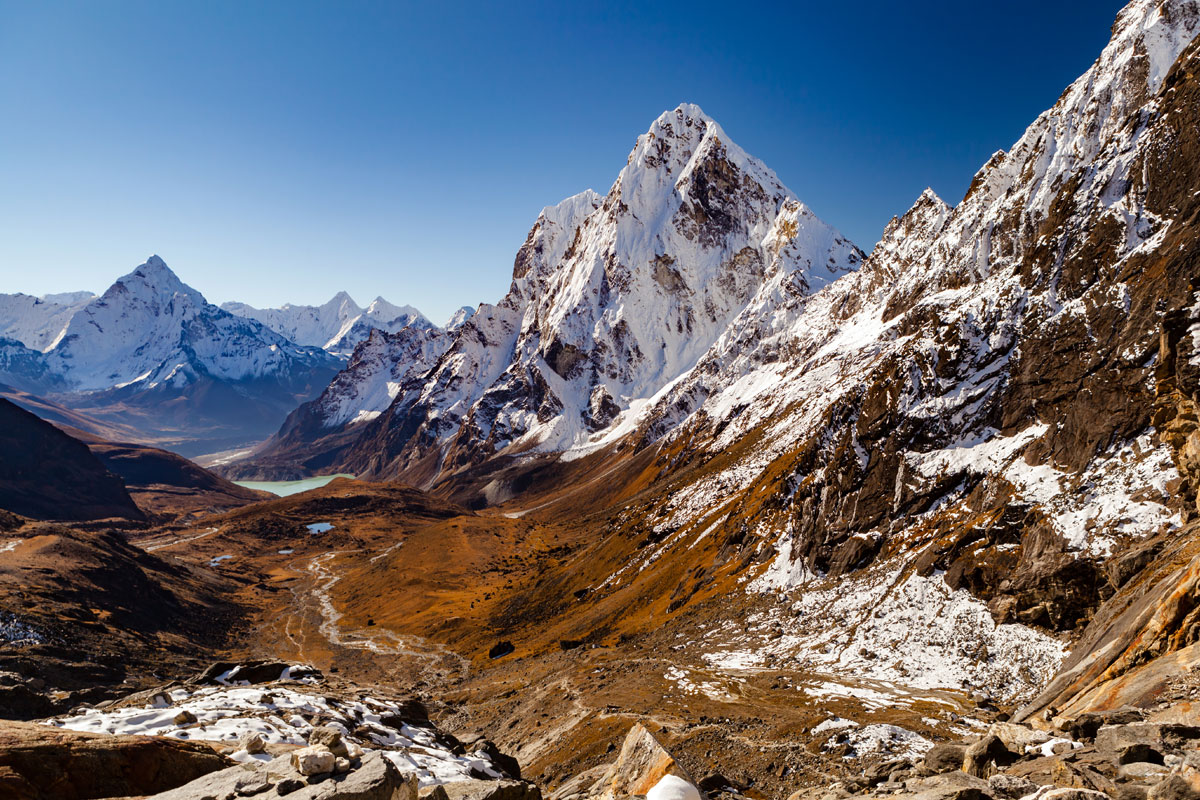
Early morning as we get out of our lodge we are greeted by the mesmerizing sight of Cholatse looming over. Today is going to be one of the toughest days of our trip. The walk begins as we transverse through a spur extending westward from Dzongla. The path descends to a basin across which meanders a murmuring stream crusted with ice at places. In about an hour, we reach the top of the basin readying for the triumph on ChoLa. As we gain height, the view back gets increasingly more captivating; the Cho La Lake begins to appear and the Ama Dablam in its pyramidal incarnation presides over a range of mountains on the south as Cholatse soars on the west. Climbing the incline is not easy; it is steep, but made worse by boulders over some of which we will have to scramble. We need to be alert as rocks can be glazed by ice. The final climb to the ChoLa can be a little tricky as the trail curves round the bergschrund. Upon reaching the top, we see prayer flags, strung across cairns, flapping in the strong wind. Scenery of majestic peaks in all directions is breathtaking. Although long, the path leading down to Thangnak can be easily made out from the pass because it is just decent but can be hazardous if rocks are glazed by ice, a bit of cautiousness is needed. We reach Thangnak, a rather more substantial hamlet with a small village. Stepping out of the settlement, we are greeted by fabulous mountain views. The trail brings us to the Ngozumpa glacier edge after short walk, which is longest glacier in Nepal. Reaching the other side of the glacier, we get view of the second of the Gokyo lakes on the series of six lakes. A short distance away is the third Gokyo Lake. On the edge of this lake stands the Gokyo Village where we finally give rest to our tired body.
| Accomodation: | Lodge (Twins Room) |
| Activity Duration: | 5km, 3-4hrs |
| Meals: | Breakfast, Lunch, Dinner |
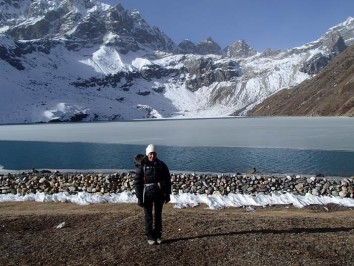
The views in the Gokyo region are tremendous. For the best view, climb Gokyo Ri (5350 m) the small peak above the lake. The peak of 5350m is sometime called Kala Pathar (not to be confused with the Kala Pathar above Gorakshep, though the view is similar) It is a two- hours climb to the top of the peak, providing a panoramic view of Cho Oyu, Gyanchung King, Everest, Lhotse, Makalu, Cholatse, Tawache and many more. Those with more time and energy can make a trip up the valley to another lake, marked with the name Ngazumpa on the maps, or even beyond to a fifth lake. There are several small peaks in this in this region that offer vantage points for the surrounding peaks and views of the Nangpa La, the old trade route into Tibet.
| Accomodation: | Lodge (Twins Room) |
| Activity Duration: | 13km, 8-9 hrs. |
| Meals: | Breakfast, Lunch, Dinner |
We need to start at dawn today as we have to trace our trail up to Marlung (4210m), after conquest of Renjo La (5345m). as there is no alternative to Marlung for overnight today. The path climbs gently up the flank of Gokyo Ri and then zigzags precariously up a finger of gray scree above the northwest corner of the lake. We proceed early down from the Gokyo Valley, We leave the main trail and turn to Renjo La trail by Dudh Pokhari. After about 3 hours, we gain the Renjo La where a dazzling vista awaits. The Everest itself, Lhotse, Cholatse and Taboche can be seen shining in the sun. Views from Renjo La are much like that from Gokyo Ri with third Gokyo Lake and Gokyo Village beneath the gray smear of Ngozumpa Glacier. Continuing on from the pass, the trail winds down a stone staircases and then scramble over loose scree to reach the south bank of a small lake, Angladumba Tsho. Presence of ice on the trail while descending down can make our descend a bit hazardous. Along the way we see Relama Tsho and Renjo Lake. However, we walk down through narrow valley clogged with giant boulders to Lumde where there is a support Lodge but it can be closed often. We walk almost for an hour from Lumden (4350m) to get to Marlung on the east bank of the Bhote Kosi.
| Accomodation: | Lodge (Twins Room) |
| Activity Duration: | 13km, 7-8 hours. |
| Meals: | Breakfast, Lunch, Dinner |
The descent from Marulung to Thame follows a traditional route used for centuries by the Tibetan traders. Down from the Marulung we cross the Bhote Kosi and descend to Taranga. The trail then goes through the valley of Langmuche Khola. This stream drains down from Dig Tsho, the glacial lake that burst its banks in 1985, causing devastating floods along the Dudh Kosi Valley to moraine to Thame. Thame has a sprawling village with a few lodges and stunning mountains like Thamserku, Katenga, Kusum Kangguru, etc. Overlooking Thame is its famous Gompa situated some the fields, on a hill to the west. Established some 325 years ago, the Gompa has three big images of Chenresig (Avalokiteswara), Guru Rimpoche, Buddha Sakyamuni. Colorful Mani Rimdu festival featuring colorful mask dances is held in this Gompa in May. We climb down after crossing a bridge after then eventually reach Samde. The place offer breathtaking views. The path steeply descends down to Thamo village which hosts a monastery called Khari Goma which is a nunnery being home to some nuns and monks. After passing through a check post, we come to the world`s highest hydroelectric power station built on Austrian help. The project provides electricity to most parts of upper Khumbu. We reach small village of Phurte where there is Laudo monastery which is run by Kopan monastery of Bouddhanath in Kathmandu and is popular among the westerners for Buddhist study and meditation center. We eventually reach Namche again through some Gompas, colorful prayer flags, Mani walls and Chortens.
| Accomodation: | Lodge (Twins Room) |
| Activity Duration: | 19km, 8-9 hrs. |
| Meals: | Breakfast, Lunch, Dinner |
After Breakfast, retrace the main trail down to Dhudh koshi waving hands to Namche and Khumbu Himalayas to national park exit check point Joralle.Trail follows down steam of Dudh Koshi river retracing to Phakding. Trail leads to Lukla scaling different Sherpa villages crossing a suspension bridge above Thado Kosh. Last section of the day, about 45 minutes ascend to accomplish entire trek. Reconfirm flight Ticket and see off to local porters.
| Accomodation: | 3 Star Hotel (Twins Room) |
| Activity Duration: | 35 minutes airstrip |
| Meals: | Breakfast, |
Fly Back to Kathmandu (35 minutes) in the morning and transfer to Hotel. Free afternoon. Overnight in Kathmandu at Boutique Hotel with breakfast
| Meals: | Breakfast, |
Transfer to international airport and fly to onward destination.
The Everest Three High Pass Trek is one of Nepal’s most adventurous and challenging high-altitude treks, crossing Kongma La (5,535m), Cho La (5,420m), and Renjo La (5,360m). Organized by Mountain Mart Treks & Expedition Pvt. Ltd., this trek combines remote Himalayan trails, Everest Base Camp, Gokyo Lakes, and panoramic Himalayan views in one epic journey.
This trek is considered very challenging and suitable for experienced trekkers with good physical fitness. Long walking days, high altitude, and steep passes require strong endurance. Mountain Mart Treks ensures proper acclimatization days and expert guides for safety and success.
The standard Everest Three High Pass Trek itinerary takes 18–21 days, depending on acclimatization, weather, and trekking pace. Mountain Mart Treks & Expedition Pvt. Ltd. can also customize the itinerary based on your time and fitness level.
The best seasons are spring (March–May) and autumn (September–November). These months offer stable weather, clear mountain views, and safer pass crossings. Mountain Mart Treks strongly recommends these seasons for the best trekking experience.
You will need:
Mountain Mart Treks & Expedition Pvt. Ltd. arranges all required permits for a hassle-free trek.
Accommodation is mainly in tea houses and lodges, offering basic but comfortable rooms. In remote areas, facilities may be limited. Mountain Mart Treks carefully selects the best available lodges to ensure comfort and hygiene.
Yes, altitude sickness is a serious concern due to elevations above 5,000 meters. Mountain Mart Treks follows a safe acclimatization schedule, provides experienced guides trained in altitude awareness, and carries basic medical kits to minimize risks.
You should have excellent physical fitness, previous high-altitude trekking experience, and strong mental endurance. Regular cardio, hiking, and strength training before the trek are highly recommended by Mountain Mart Treks.
Yes, the Everest Three High Pass Trek includes both Everest Base Camp and the stunning Gokyo Lakes, making it one of the most complete trekking experiences in the Everest region.
Meals are served at tea houses and include Nepali, Tibetan, and Western dishes such as dal bhat, noodles, soups, pasta, rice, and breakfast items. Mountain Mart Treks advises high-energy meals to maintain strength at high altitude.
Yes, hiring a licensed guide is highly recommended for safety and navigation. Mountain Mart Treks & Expedition Pvt. Ltd. provides experienced, English-speaking trekking guides who know the routes, passes, and local culture well.
The cost depends on itinerary length, group size, and services included. Mountain Mart Treks offers competitive and transparent pricing with excellent value, including guides, permits, accommodation, and logistics.
Mountain Mart Treks & Expedition Pvt. Ltd. is a trusted Nepal-based trekking company known for experienced guides, safety-focused itineraries, personalized service, and deep local knowledge of the Everest region. Your adventure is handled professionally from start to finish.
Yes, Mountain Mart Treks offers fully customizable itineraries, allowing you to add rest days, side trips, or adjust trekking pace based on your needs and preferences.
Yes, comprehensive travel insurance covering high-altitude trekking and emergency helicopter evacuation is mandatory. Mountain Mart Treks will request insurance details before the trek begins.
Eating is a big part of Holiday. Travelling with Mountain Mart Trek, you experience the vast array of wonderful food Nepalese, Chinese, Continental, Italian and several local cuisines. Breakfast, Lunch & Dinner are included in the package. Your guide will suggest delicious, hygienic and each place special food during your trip. Mountain restaurant owner prefer not to order many dishes and waste food as they would like to cater more trekkers with limited food before run off stuck. Its a week or more days hard work to porters and caravans to bring food to these places. During this trek you will usually have breakfast and dinner at the same Lodge, lunch will be eaten at one of the trail side restaurants en-route.
A Tea House is the combination of guest house, restaurant, and social hang out. Private rooms are available in most Tea Houses, except for high altitudes ones where it will be just dormitories. The lodges are fairly basic. The rooms are spare with twin beds and very little additional furniture. Blankets are generally provided. There is a large dining room-cum-lounge, warmed by the bukhara stove (an iron cylinder, fitted with a chimney duct, in which a log fire is lighted. There is normally no electric lighting in the rooms unless the village has hydroelectric power. The dining room usually hassolar lighting.
Most teahouses now also have electricity for charging small appliances - mobile phones and cameras - and there may be a small charge for this.
Route Map
Mountain Mart Trek offers you complementary route map and T-shirt
This is a very active trip, meaning you will be on the move most of the time, so pack as lightly as possible. We provide one porter for every two travellers; your trekking gear will be carried by the porter in a duffel bag that we will provide. The maximum the porters are allowed to carry 15 kgs per trekker means 30 kgs from 2 trekkers . Unnecessary luggage can left in Kathmandu Hotel and its absolutely free of cost. .
Please read the Checklist section of this trip notes for additional details of what you need to bring for the trek on this trip. You will need to bring a comfortable medium sized day pack to carry the things that you will need during the day. This should have a waist strap or (better) a padded waist belt. The weather is subject to change in high altitude so layered clothing is recommended throughout the year.
Please, read MMT’s ‘Terms and Conditions’ carefully prior to trip booking
Trekking or Mountaineering in the higher elevation of the Himalayas is one of the most adventurous endeavors which inherit the risk of AMS or injuries or even death. MMT is always concern regarding the comfort, safety and health of trekkers while meandering in higher altitude. We contribute great effort to reduce or control the risk and hazard; but sometime nature’s curse or fluctuate climate in Himalayas is beyond our control and we are not responsible for it.
If you are a keen adventure lover and are ready to follow the hereby mentioned Terms and Conditions then you are heartily welcome at MMT office, Kaldhara-marg, Paknajol, Thamel, Kathmandu, Nepal.
1. All the bookings of the packages are dealt with Mountain Mart Treks and Expedition which is an authorized adventure company based in capital of Nepal: Kathmandu.
2. The term ‘Trip’ formally refers to walking, sightseeing, treks, tours, mountaineering, expeditions or holiday in the mystical land, Nepal.
3. MMT faithfully offers all the amenities in the estimated price of the package.
4. Please go through itinerary page or trek inclusion page for the detail information of the cost transparency. The trek cost may vary from one package to another and some packages don’t include the cost of the following:
5. The travelers must pay 20% upfront out of the total trip cost for the trip conformation.
6. You can pay the booking conformation amount either by credit card and wire transfer, both payment option subject to charge additional bank service fees upto 4% on top of the sum.
7. The trip will be booked once the payment is made by the travelers. We will send you the conformation letter through online and assure to provide all the service detail as mentioned in the itinerary.
8. The final payment must be submitted at the MMT office before the tip departure. Otherwise, you will not be legitimate for trip and no final documentation will be disclosed before the payment.
09. Regarding trip cancellation, we entertain free trip cancellation service upon submission of trustable reason before 90 days of the departure date upon adequate evidence and written reasons.
10. If you cancel the trip 60 days prior to the departure date then 75% cancellation fee will be levied from the booking amount.
11. 85% cancellation fee will be levied if you cancel the trip before 30 days of the trip departure date.
12. The company will be unable to refund the earlier paid (20%) booking payment if you cancel the trek prior to 15 days of the departure date.
13. There will be no payment refund if you voluntarily leave or cancel the trip once it is started; but if you are forced to leave due to unforeseen immediate circumstances then payment can be refunded after proper discretion.
14. We guarantee your safe and successful trip; however, the company reserves the authority to cancel the trip if there will be no minimum number (2) of travelers. In this condition, company will postpone or manage alternative trip.
15. If the company cancels the trip due to any unforeseen circumstances which are beyond our control (i.e. natural disaster, flight cancellation, strikes, wars, riots, quarantine, government intervention policy, weather condition), we will refund after deduction of minimum operating cost involved.
16. If you want to change your booking date, the booking amendment request must be made 90 days prior to the original trip departure.
17. If trekkers demand to change the departure date prior to 60 days of the final departure, US $ 50.00 per person will be charged as cancelation fee. The charge of the trip may also be increased if the market price soars higher during the postponed trip date.
18. The policy of our company is: Trekkers must have insurance policy contract if they want to trek with MMT. The policy must feature: medical coverage, air ambulance, helicopter evacuation facility, as well as flight cancellation insurance if possible.
19. Mountain Mart Treks and Expedition organizes various adventurous trips which have high risk factor and demand more physical stamina plus training. If you can’t accomplish the trek due to your physical inability or sickness, we are not obliged to refund the payment.
20. There may appear hindrance, obstacles or circumstances like: political riot, insurgency, accident, climate change, or natural disasters during the course of trip. Make sure you are ready to deal with all these problems.
21. The trip route, accommodation, modes of transport may be changed without prior notice due to the unforeseen circumstances. It is for your convenience and safety, so hope you will display flexible human nature in this context.
22. While changing the route, transportation, accommodation, or itinerary due to above circumstances, we may charge additional cost or lessen the cost as per the total expenses of the entire trek.
23. MMT holds all the authority to decline, accept, detain or retain any members of the trip if we find anyone suspicious or indiscipline. If you want to trek with MMT, you must accept our leadership during the whole trip.
24. MMT has contracted with network of companies, government of Nepal, individuals to assist the travelers during the trip. These third parties are qualified to perform their duties as contracted. We are not liable in case of loss, damage, irregularities if the third parties don’t perform their duties properly.
25. MMT is not responsible for the violation of any law or rules committed by the travelers in any country.
26. This agreement is governed by the laws of the Government of Nepal. No any individual: employees, representatives, guides of the company can alter the terms and conditions.
27. These terms and conditions may only be waived in special circumstances with written application to the director. Only the director of the company has all the right to amend them.
28. Travelers must be physically and mentally fit for the trekking. It is compulsory to bring health certificates along with proper legal documents for trip approval, if asked.
29. If the flight is cancelled or get delayed due to fluctuate climate or any other causes, MMT is not responsible for the extra expenses or compensation. We can manage alternative arrangement on special request which may demand other extra cost.
30. We have displayed the authentic, genuine and accurate information on our official website and brochure. If any mistake, incomplete or wrong information is seen, please inform us on time.
31. Please read all the above mentioned ‘Terms and Conditions’ before making the bookings. You must abide these conditions if you fancy to trek in the Himalayas with Mountain Mart Treks (MMT)
Foreigners other than Indian citizen, who intend to visit Nepal must hold a valid passport prior to applying for a Nepal visa. The passport must have six months validity from the date of arrival. Foreigners can obtain a Nepalese visa upon arrival at Kathmandu airport, or at a border immigration office. One recent copy of a passport size color photo is required to apply for Tourist Visa to Nepal. Mountain Mart Trek has listed Nepal visa information tips for travelers to Nepal.
A foreigner who has departed before the expiry of the period specified in the visa issued in a visa year shall not be allowed to use the visa by adding the remaining period to another visa year. If any foreigner who has entered Nepal towards the end of a visa year desires to extend his/her stay into the new visa year, he/she may do so by purchasing another visa for the New Year. Provided, however, that the computation of the fees for such period shall be made on the basis of the total period of the stay.
An application for a Tourist Visa must be submitted in the format referred to in Appendix 1.
A Nepali visa issued abroad is valid for entry for three to six months from the date of issue. True -
Citizens of the following countries should be issue visa in their own country to Nepal embassy and consulate.
Afghanistan, Cameroon, Ethiopia, Ghana, Iraq, Liberia, Nigeria, Palestine, Somalia, Zimbabwe.
No foreigners except Indians are entitled to Nepal without a valid visa.
Visas can be obtained from the following immigration offices in Nepal:
A copy of the Visa Form is available for use at the end of this document that avoids you long queue to pick up the Nepal visa form at the international airport.
The fees payable only in USD dollars for obtaining a visa on arrival at any border are as follows:
The fees payable (only in local Nepali currency) to extend the duration of your stay, or to renew a visa are:
A transit visa for one day can be obtained from Nepal's immigration offices at an entry point upon the production of a departure flight ticket via Tribhuvan International Airport in Kathmandu. The fee is US$ 5 or equivalent convertible currency. A transit visa may not be extended.
A Nepali Visa can be obtained from Nepal Embassy / Consulate Offices in your country, or upon arrival at Kathmandu airport. It is also possible to obtain the visa from other border points of entry. You'll need 1 passport photo each time.
For foreign investors, a business visa with a multiple entry facility for a period of one year or five years can be obtained from the Department of Immigration on the recommendation of the Department of Industry and Commerce by paying US$ 100 and US$ 250 or equivalent convertible foreign or Nepali currency.
Note: While we try to make the information contained herein as accurate as possible, we accept no responsibility for any loss, disruption or inconvenience sustained by anyone using this information.
Foreign visitors are requested to keep a note of the dates on their Nepalese visa and their passport number to avoid possible problems. Visa extensions need to be applied for, within the valid period of the Nepalese visa.
You are requested to ensure that you get the arrival/departure stamps on your passport at the entry /exit points to avoid possible legal complications.
Living in Nepal without a passport or a valid visa is a punishable offence.
Deviation from the prescribed trekking routes mentioned on your trekking permit will be treated as a violation of the law.
You are advised to be aware of brokers/cheaters and counterfeit documents or visa/trekking permits to avoid legal complications.
Change of purpose of your stay without permission is not allowed and employment or voluntary services while on a tourist visa is strictly prohibited. It will be a punishable offence.
Be certain to register at the police and Immigration check points along any trail. It would be wise to register your trekking destination and schedule at your Embassy or Consulate.
If you encounter problems along the trails, immediately inform the nearest police or Immigration post officials.
You are requested to change money with recognized dealers and do not forget to take and keep formal receipts.
You are requested to inform the officials at an Immigration Office or Police Station of any changes in the address previously given in your visa application form or disembarkation card, and within seven days.
If, as a tourist, your stay is more than 120 days in one visa year and you wish to visit additional places for longer than 24 hours, you must register at the local police office of such places, your name, passport number and address.
You are advised to be mindful to contact the Department of Immigration to request a visa transfer in the case of getting a new passport or travel document from your embassy, and within seven days.
Passport and trekking permits should be kept by each trekker while trekking.
Filming in restricted or notified areas without permission is strictly prohibited.
Please do not take out the visa stickers from your passport and do not try to change records printed in your passport.
We request your co-operation in observing the following guidelines during your stay in Nepal. Respect local traditions, customs, values and sentiments, help to protect local culture and maintain local pride.
Indian citizens are permitted to travel in Nepal provided they have any one of the following documents:
Passport; Driving license with photograph; Identity card with photograph issued by a governmental body; Ration card with photograph; Voter identity card with photograph; Registration certificate issued by the Indian embassy to Indian citizens residing in Nepal; Ad hoc/temporary identity cards issued by the Indian embassy to the Indian citizen in the event of exigency; Document with photograph and setting out identity, issued by the sub-divisional magistrate or authority there above.
| Department of Immigration Kalikasthan, Dillibazar, Kathmandu. |
|
| Tel : | 977 - 01 - 4433934 / 4429660 / 4438862 / 4438868 |
| Fax : | 977 - 01 - 4433935 |
| Email : | mail@nepalimmigration.gov.np |
| Web : | http://nepalimmigration.gov.np/ |
| Sunday to Thursday | 10:30 a.m. - 17:00 p.m. in Summer |
| 10:30 a.m. - 16:00 p.m. in Winter (Nov. to Jan.) | |
| Friday | 10:30 a.m. -15:00 p.m. |
| Sunday to Thursday | 10:30 a.m. - 15:00 p.m. |
| Friday | 10:30 a.m. - 13:00 p.m. |
Note: All of the information above is based on information from the Department of Immigration of Nepal’s office and may be found on their website.
All trekkers are required to carry a Trekkers' Information Management System card (TIMS card). It is available from the Tourist Services Centre in Kathmandu: Sun – Fri 10:00 – 13:00 and 14:00 – 17:00. It is free, but requires two passport photographs. (Trekking agencies provide the cards for their clients.) Show it at check points on trekking routes.
Trekking Permits are required for all treks that pass through Conservation Areas or National Parks.
Conservation Area permits can be purchased at the Tourist Services Centre for Rs 2000 plus two photographs.
National Park entry tickets cost Rs 3000 and require no photograph. Purchase at the Department of National Parks and Wildlife Conservation office Sun – Fri 09:00 – 14:00 only (next to the Tourist Services office).
Restricted Area Permits are required mainly for camping style trekking in remote areas near the Tibetan border – for which a guide is strongly recommended. They can only be purchased for two or more trekkers. The permits are issued by the Central Immigration Office, require two working days, your original passports (not facsimiles) and two photographs. Costs range from US$10/week to US$500/10 days plus substantial additional amounts for each additional day. These will be procured by your chosen trekking agency. Offices are open daily, but with restricted hours on Saturdays.
The foreign tourist visiting Nepal shall be granted the tourist visa.
The tourist visa shall be granted for a period in maximum of 150 days in a visa year (Visa years means January to December).
A tourist who has departed before the expiry of the period specified in the visa issued in a visa year shall not be allowed to use the visa by adding the remaining period to another visa year.
If any foreigner who has entered into Nepal towards the end of a visa year desires to spend even the period during which he may stay in Nepal with the tourist visa of the other visa year, he may use such facility.
Provided, however, that the computation of the fees for such period shall be made on the basis of the total period of his stay.
Note: Above information is based on Department of Immigration of Nepal office.

Mountain Mart Treks & Expedition Pvt. Ltd. follows strict professional standards for all field staff, including guides, assistant guides, and porters. Our team members are government-licensed, well-trained, and experienced in Himalayan trekking and expeditions. They are required to respect local cultures, protect the environment, maintain ethical conduct, and prioritize guest safety at all times. Friendly communication, honesty, punctuality, and professional service are core values we uphold throughout every journey.
Guest safety is our highest priority. All trekking routes are carefully planned with proper acclimatization and daily safety briefings. Our guides are trained in first aid and altitude awareness, and they closely monitor trekkers’ health during the trip. We use reliable equipment, trusted accommodation, and established emergency procedures, including evacuation support when needed. With Mountain Mart Treks & Expedition Pvt. Ltd., travelers can explore Nepal with confidence and peace of mind.
Nepal offers excellent trekking opportunities throughout the year, but the best seasons are spring (March to May) and autumn (September to November). During these months, the weather is stable, skies are clear, and mountain views are spectacular. Spring brings colorful rhododendron forests, while autumn offers crisp air and stunning Himalayan panoramas. Winter and monsoon treks are also possible in selected regions with proper planning and guidance.
Our trekking and adventure programs are designed for a wide range of experience levels—from beginners to experienced trekkers and mountaineers. Most treks require a good level of physical fitness, regular walking ability, and a positive mindset. Prior trekking experience is helpful but not always necessary. We provide clear pre-trip information to help guests prepare physically and mentally for a rewarding Himalayan journey.
Proper acclimatization is essential for a safe and enjoyable trek in Nepal. Our itineraries are carefully designed with gradual altitude gain and scheduled rest days to help the body adapt naturally. Guides continuously assess guests’ condition and provide guidance on hydration, pacing, and altitude awareness. This approach greatly reduces the risk of altitude-related illness and ensures a comfortable trekking experience.
Mountain Mart Treks & Expedition Pvt. Ltd. is committed to responsible and sustainable tourism in Nepal. We follow eco-friendly trekking practices by minimizing waste, promoting reusable products, supporting local communities, and respecting wildlife and natural resources. Our goal is to preserve the pristine Himalayan environment while providing meaningful travel experiences for future generations.
We specialize in tailor-made itineraries designed to match each traveler’s interests, schedule, fitness level, and travel style. Whether you prefer a relaxed cultural trek, an adventurous high-altitude journey, or a private family trip, our team customizes every detail for a personalized experience. From arrival to departure, Mountain Mart Treks & Expedition Pvt. Ltd. ensures flexible planning, expert guidance, and exceptional service.
Planning the Everest Three High Pass Trek in the breathtaking Khumbu region requires proper travel insurance, emergency rescue coverage, and helicopter evacuation support. This challenging Himalayan adventure crosses three high mountain passes — Kongma La Pass (5,535m), Cho La Pass (5,420m), and Renjo La Pass (5,340m) — while also visiting the legendary Everest Base Camp (5,364m) and the famous viewpoint Kala Patthar (5,545m).
Because this trek involves extreme altitude, remote mountain terrain, and rapidly changing weather, trekkers may face risks such as altitude sickness, injuries, or unexpected delays. Therefore, comprehensive high-altitude travel insurance is essential for a safe and worry-free trekking experience in Nepal.
Before beginning your journey from Kathmandu or taking the scenic mountain flight to Tenzing-Hillary Airport in Lukla, make sure your travel insurance policy covers high-altitude trekking up to at least 6,000 meters.
Your Everest Three Pass Trek insurance policy must include:
✔️ High-altitude trekking coverage (above 5,500m)
✔️ Emergency helicopter rescue & evacuation
✔️ Medical treatment and hospitalization
✔️ Trip cancellation or trip interruption
✔️ Accidental injury & emergency repatriation
✔️ Lost, stolen, or delayed baggage
Without proper travel insurance, helicopter rescue in the Everest region can cost between USD 5,000 and USD 8,000+, depending on altitude, location, and weather conditions.
The Everest Three High Pass Trek route is one of the most demanding trekking circuits in Nepal. Trekkers must cross glaciers, steep passes, and remote alpine valleys.
If a trekker develops Acute Mountain Sickness (AMS), suffers an injury, or faces a medical emergency, immediate descent and evacuation may be required.
In such cases, helicopter evacuation is the fastest and safest rescue method in the Everest region.
1. Inform your trekking guide immediately if you feel unwell.
2. Your trekking agency coordinates with rescue operators and your insurance provider.
3. A helicopter evacuation is arranged from the nearest safe landing location.
4. You are transported to a hospital in Kathmandu for medical treatment.
Most helicopter rescues are handled by experienced aviation companies operating in the Everest region, ensuring rapid response even in remote high-altitude areas.
The Everest Three Pass Trek includes several remote and high-altitude highlights:
✔️ Trekking through Sagarmatha National Park
✔️ Crossing the challenging Kongma La, Cho La, and Renjo La passes
✔️ Visiting Everest Base Camp (5,364m)
✔️ Hiking to Kala Patthar (5,545m) for panoramic Everest views
✔️ Exploring famous Sherpa villages like Namche Bazaar and Tengboche Monastery
✔️ Trekking through remote mountain terrain with limited medical facilities
Because of the high altitude, unpredictable Himalayan weather, and isolated trekking routes, travel insurance with emergency evacuation coverage is mandatory for all trekkers.
✔️ Carry both digital and printed copies of your insurance policy.
✔️ Confirm that your insurance covers trekking up to at least 6,000 meters.
✔️ Provide your insurance details to your trekking agency before the trek begins.
✔️ Trek with a licensed and experienced guide for safety and proper acclimatization.
✔️ Inform your guide immediately if you experience symptoms of altitude sickness.
Choosing the right insurance, rescue, and evacuation coverage for the Everest Three High Pass Trek ensures peace of mind while exploring the spectacular Himalayas. With proper protection, trekkers can confidently enjoy glacier crossings, dramatic mountain passes, breathtaking views of Mount Everest, and authentic Sherpa culture without unnecessary risk.
For a safe, secure, and professionally organized Himalayan adventure, always travel well prepared, fully insured, and guided by experienced trekking professionals.
During the Everest Three High Pass Trek, electricity and battery charging facilities are available in most villages along the trekking route. However, services become more limited and expensive at higher elevations, especially when crossing the famous high mountain passes — Kongma La (5,535m), Cho La (5,420m), and Renjo La (5,340m).
This challenging trekking adventure in the Everest region also visits the legendary Everest Base Camp (5,364m) and the famous viewpoint Kala Patthar (5,545m). Because of the extreme altitude and remote Himalayan terrain, trekkers should plan ahead to manage battery usage and charging needs.
While trekking through traditional Sherpa villages and alpine landscapes inside Sagarmatha National Park, charging services are generally available in teahouses, particularly in popular stops such as Namche Bazaar, Tengboche Monastery area, Dingboche, Lobuche, Gokyo, and Gorakshep.
Villages along the Everest Three Pass Trek route including Tenzing-Hillary Airport area (Lukla), Namche Bazaar, Tengboche, Dingboche, Lobuche, Gokyo, and Gorakshep provide electricity powered mainly by small hydroelectric systems or solar energy.
However, trekkers should keep in mind:
Electricity is not available 24 hours a day
Solar energy is common at higher altitudes
Charging availability may be limited during cloudy or snowy weather
Dining halls are usually the main charging location in teahouses
Higher elevations have weaker and less reliable power supply
As you approach the high passes and Everest Base Camp, electricity becomes more limited and expensive.
Charging costs increase as you ascend deeper into the Everest region and cross higher mountain passes.
Typical charging costs are:
Lukla / Namche Bazaar: USD 2–3
Tengboche / Dingboche: USD 3–4
Lobuche / Gorakshep / Gokyo: USD 4–6
Charges are usually per device, including:
Mobile phones
Cameras
Power banks
Laptops (usually higher cost)
Prices rise at higher elevations due to limited solar energy, transportation logistics, and remote mountain conditions.
✔️ Carry a high-capacity power bank (10,000–20,000mAh or more)
✔️ Bring extra camera batteries
✔️ Use airplane mode to save battery life
✔️ Turn off Wi-Fi, Bluetooth, and GPS when not needed
✔️ Keep electronic devices warm inside your jacket (cold temperatures drain batteries quickly)
✔️ Consider carrying a small portable solar charger for backup
Wi-Fi services are available in some lodges along the Everest Three Pass Trek route, particularly in villages like Namche Bazaar and Gokyo, but they are paid and often slow due to remote Himalayan connectivity.
In conclusion, electricity on the Everest Three High Pass Trek is basic but manageable with proper preparation. By carrying backup power sources and managing battery usage carefully, trekkers can stay connected, charge essential devices, and capture stunning Himalayan moments throughout this incredible high-altitude adventure.
With good planning, you can safely enjoy glacier crossings, spectacular mountain passes, and breathtaking views of Mount Everest and the surrounding Himalayan peaks without worrying about power shortages.
While booking the Everest Three High Pass Trek, it is important to understand the personal expenses that are not included in the standard trekking package cost. This challenging Himalayan adventure takes you through remote high-altitude trails in the Everest region, crossing the famous passes Kongma La (5,535m), Cho La (5,420m), and Renjo La (5,340m).
Trekkers also visit iconic destinations such as Everest Base Camp (5,364m) and the stunning viewpoint Kala Patthar (5,545m) inside Sagarmatha National Park. Because the Everest Three Pass route is remote and physically demanding, personal spending depends on your comfort level, travel style, and daily needs.
Below is a clear breakdown of common personal expenses to help you properly plan your trekking budget.
Hot drinks and bottled items become more expensive as you ascend toward higher elevations such as Gokyo, Lobuche, and Everest Base Camp.
Typical prices:
Tea / Coffee: USD 2–5 per cup
Hot Lemon / Ginger Tea: USD 3–5
Bottled Water: USD 2–5 (price increases with altitude)
Soft Drinks: USD 3–5
Beer: USD 6–10
💡 Tip: Carry a reusable water bottle and water purification tablets to reduce daily costs and minimize plastic waste in the mountains.
In villages such as Namche Bazaar, Gokyo, Dingboche, and Lobuche, lodges charge extra for electricity and internet services.
Typical costs include:
Mobile charging: USD 2–6 per device
Power bank charging: USD 3–6
Wi-Fi internet: USD 3–8
Electricity is limited in high-altitude areas, so prices increase as you trek deeper into Sagarmatha National Park.
Facilities become more basic at higher elevations along the Everest Three Pass Trek route.
Typical costs:
Hot shower: USD 4–8 per use
Laundry service (limited availability): USD 5–10
Extra blankets (in some lodges): small additional fee
Prices rise significantly in higher villages like Lobuche and Gorakshep due to transportation costs and limited resources.
Snacks are available along the trail but cost much more than in Kathmandu because goods are transported by porters, yaks, or mules.
Typical prices:
Chocolate / Energy Bars: USD 2–5
Biscuits / Chips: USD 2–4
Toiletries (if purchased during the trek): higher than Kathmandu prices
💡 Recommendation: Buy your snacks, energy bars, and personal supplies in Kathmandu before flying to Lukla to save money.
Tipping is a common and appreciated practice in Nepal’s trekking culture.
Typical tipping guidelines:
Guide: USD 10–15 per day (group basis)
Porter: USD 7–10 per day
Tips depend on service quality, trek duration, and group size.
On average, trekkers should budget approximately:
👉 USD 20–35 per day for personal expenses
Your spending may increase if you frequently purchase alcoholic drinks, bottled water, Wi-Fi services, or extra snacks.
✔️ Carry enough Nepali cash (ATMs are available mainly in Lukla and Namche Bazaar)
✔️ Expect prices to increase with altitude
✔️ Avoid unnecessary bottled water purchases
✔️ Plan your daily personal spending in advance
✔️ Bring snacks and personal supplies from Kathmandu
Personal expenses on the Everest Three High Pass Trek are manageable with proper budgeting. Since this trekking route passes through remote Himalayan terrain, goods must be transported by porters, mules, or yaks, which increases prices at higher elevations.
By planning your daily trekking expenses carefully, you can fully enjoy this incredible adventure across the Everest Three Passes, glacier valleys, and spectacular Himalayan landscapes without unexpected financial surprises.
Hiring a professional guide and porter service for the Everest Three High Pass Trek is highly recommended for safety, comfort, and a successful Himalayan adventure. This challenging trek in the Everest region crosses three high mountain passes — Kongma La (5,535m), Cho La (5,420m), and Renjo La (5,340m) — while also visiting the legendary Everest Base Camp (5,364m) and the famous viewpoint Kala Patthar (5,545m).
Because this trek involves high altitude, glacier crossings, and remote Himalayan terrain, having experienced local support greatly improves safety and overall trekking experience.
Whether you are trekking solo or in a group, a licensed trekking guide and reliable porter make the Everest Three Pass adventure smoother, safer, and more enjoyable.
A professional trekking guide in the Everest region plays a vital role during this demanding trek.
A licensed guide provides:
✔️ Professional route navigation across high mountain passes
✔️ Proper altitude acclimatization guidance
✔️ Knowledge of Sherpa culture and Himalayan traditions
✔️ Emergency response and rescue coordination
✔️ Teahouse booking and accommodation management
✔️ Flexible daily itinerary adjustments based on weather and health
The trekking route passes through major villages including Tenzing-Hillary Airport area (Lukla), Namche Bazaar, Tengboche, Dingboche, Lobuche, Gokyo, and Gorakshep inside Sagarmatha National Park.
Weather conditions in the high Himalayas can change rapidly, especially while crossing the Three High Passes. An experienced guide ensures safe decision-making and proper acclimatization throughout the trek.
Hiring a porter for the Everest Three Pass Trek allows trekkers to walk comfortably while someone carries the heavier luggage.
A porter typically carries 20–25 kg (shared between two trekkers), leaving you with only a small daypack for daily essentials.
✔️ Reduces physical strain at high altitude
✔️ Conserves energy for demanding passes like Kongma La and Cho La
✔️ Makes the trek more comfortable and enjoyable
✔️ Supports local employment in the Everest region
Porters are experienced, strong, and well adapted to the mountain environment, making them an important part of the trekking team.
Average daily costs in the Everest region:
Licensed Guide: USD 30–35 per day
Porter: USD 20–25 per day
These prices typically include:
Staff salary
Meals and accommodation during the trek
Insurance and trekking equipment
Costs may vary slightly depending on season, trek duration, and group size.
Hiring a guide and porter service for the Everest Three High Pass Trek provides many safety advantages:
✔️ Better monitoring of altitude sickness symptoms
✔️ Quick response in case of emergency
✔️ Organized logistics from Lukla onward
✔️ Easier communication with local teahouses and lodges
✔️ Stress-free trekking experience
Professional trekking companies ensure their guides and porters are licensed, insured, and experienced in high-altitude trekking routes.
The Everest Three High Pass Trek guide and porter service is not just about carrying luggage — it ensures safety, cultural insight, and a higher chance of successfully completing one of Nepal’s most demanding trekking routes.
With experienced local support, trekkers can fully enjoy spectacular Himalayan scenery, dramatic glaciers, high mountain passes, traditional Sherpa villages, and breathtaking views of Mount Everest and surrounding peaks.
For a safe, comfortable, and professionally managed trekking experience in the Everest region, hiring a licensed guide and porter is always the smartest and most responsible choice.
Reliable transport service for the Everest Three High Pass Trek is an important part of your overall trekking arrangement in the Everest region. This adventurous trekking route crosses three high Himalayan passes and begins with access to the remote mountain town of Lukla. Proper flight and ground transportation planning ensures a smooth and stress-free start to your Everest trekking adventure.
The Everest Three Pass Trek also includes visits to famous destinations such as Everest Base Camp (5,364m) and the panoramic viewpoint Kala Patthar (5,545m) inside Sagarmatha National Park.
The most common and fastest way to start the Everest Three High Pass Trek is by taking a scenic mountain flight from Kathmandu to Lukla.
Flights land at Tenzing-Hillary Airport, one of the world’s most famous mountain airports and the main gateway to the Everest region.
Flight Details:
Flight Duration: 30–35 minutes
Airlines: Domestic airlines operating daily flights (weather permitting)
Best For: Quick access and breathtaking aerial views of the Himalayas
During peak trekking seasons such as spring (March–May) and autumn (September–November), many flights may operate from Ramechhap Airport instead of Kathmandu due to heavy air traffic.
For trekkers who prefer more comfort or flexible travel schedules, a helicopter charter to Lukla is a premium transport option.
✔️ Flexible departure times
✔️ Faster and more comfortable access to the Everest region
✔️ Ideal for groups or luxury trekking packages
✔️ Operates during limited weather windows when flights are delayed
Helicopters are also commonly used for emergency evacuation during high-altitude trekking in the Everest region.
Before and after your trek, transportation services usually include comfortable private transfers within Kathmandu.
Typical services include:
✔️ International airport pick-up and drop-off
✔️ Hotel transfers in Kathmandu
✔️ Private sightseeing transportation (if requested)
Professional trekking agencies arrange private tourist vehicles for convenient and comfortable city travel.
Some trekkers choose to avoid Lukla flights by traveling by road from Kathmandu to Salleri or Phaplu, followed by trekking to Lukla.
Reduces dependency on Lukla flights
Offers additional trekking experiences through local villages
Can be more budget-friendly
However, this route adds extra trekking days and requires additional physical endurance.
✔️ Flights to Lukla are highly weather dependent
✔️ Keep 1–2 buffer days in your itinerary for delays
✔️ Book flights early during peak trekking seasons
✔️ Travel light due to flight baggage limits (usually 15 kg total including hand carry)
✔️ Stay flexible with possible schedule changes
Well-organized transport service for the Everest Three High Pass Trek ensures a smooth start and successful completion of your Himalayan adventure. Whether traveling by scenic mountain flight, helicopter charter, or road alternative, reliable transportation plays a crucial role in reaching the Everest region safely.
By choosing a professional trekking company, you benefit from well-managed transport arrangements, allowing you to fully focus on the spectacular mountain landscapes, thrilling high passes, Sherpa culture, and unforgettable trekking experience in the Everest region.
Booking your Everest Three High Pass Trek with a professional trekking company ensures a smooth, secure, and well-organized Himalayan adventure in the Everest region. This challenging trek crosses three famous mountain passes — Kongma La (5,535m), Cho La (5,420m), and Renjo La (5,340m) — while also visiting the legendary Everest Base Camp (5,364m) and the iconic viewpoint Kala Patthar (5,545m).
Because this is one of the most demanding trekking routes in Nepal, advance booking and clear payment procedures are strongly recommended to secure flights, guides, and accommodation along the route.
The booking process is simple, secure, and traveler-friendly.
Contact us with your preferred trekking dates, group size, and special requirements for the Everest Three Pass Trek.
We check Lukla flight availability, guide and porter schedules, and teahouse accommodation along the trekking route inside Sagarmatha National Park.
Trekkers must provide:
A copy of passport
Valid travel insurance covering high-altitude trekking
Secure your trek with an advance payment deposit.
After payment, you will receive official booking confirmation, trip details, and pre-departure information via email.
Early booking is highly recommended during peak trekking seasons (March–May and September–November).
To confirm your booking, a 20–30% advance deposit of the total trek cost is required.
Bank transfer to the company account
Online secure payment system
Credit card payment (service charge may apply)
Cash payment upon arrival in Kathmandu
The remaining balance can be paid after arrival in Kathmandu before the trek departure.
Your Everest Three High Pass Trek package typically includes:
✔️ Domestic flight Kathmandu – Lukla – Kathmandu via Tenzing-Hillary Airport
✔️ Trekking permits and entry fees for Sagarmatha National Park
✔️ Licensed trekking guide and porter services
✔️ Teahouse accommodation during the trek
✔️ Three meals per day during trekking
✔️ Government taxes and service charges
The following personal expenses are usually not included in the package:
International airfare
Travel insurance
Personal trekking equipment
Wi-Fi, hot showers, and battery charging
Alcoholic beverages and bottled drinks
Personal expenses and tips for guide and porter
The booking deposit is generally non-refundable, but it may be transferred to a future trekking date according to company policy.
Flights to Lukla are highly weather-dependent, and delays are common in the Everest region.
In case of trip cancellation:
Refund terms depend on company policy and airline conditions
We recommend purchasing comprehensive travel insurance that covers high-altitude trekking and helicopter evacuation
Trekkers are also advised to book flexible international flight tickets.
Clear booking policies and payment terms for the Everest Three High Pass Trek ensure transparency, financial security, and proper trip organization.
By confirming your trek in advance with a reliable trekking company, you secure experienced guides, Lukla flights, and comfortable teahouse accommodation along the route.
With everything arranged in advance, you can focus on preparing for one of the most thrilling Himalayan adventures — crossing the Everest Three High Passes while enjoying spectacular views of Mount Everest, glaciers, Sherpa villages, and high-altitude landscapes.
The Everest Three High Pass Trek is considered one of the most challenging trekking adventures in Nepal. This spectacular route in the Everest region crosses three major Himalayan passes — Kongma La (5,535m), Cho La (5,420m), and Renjo La (5,340m) — while also visiting the legendary Everest Base Camp (5,364m) and the famous viewpoint Kala Patthar (5,545m).
This trek offers breathtaking views of Mount Everest and surrounding Himalayan peaks, but it also requires strong physical endurance and proper preparation. Understanding the difficulty level of the Everest Three Pass Trek and following effective training tips greatly improves your chances of a safe and successful journey.
The Everest Three High Pass Trek is graded as challenging to strenuous, mainly due to:
High altitude above 5,000 meters
Long trekking days of 6–8 hours
Steep ascents and descents across mountain passes
Glacier crossings and rocky alpine terrain
Cold temperatures and unpredictable Himalayan weather
The trekking route passes through famous Sherpa villages including Tenzing-Hillary Airport area (Lukla), Namche Bazaar, Tengboche, Dingboche, Lobuche, and Gokyo within Sagarmatha National Park.
Although no technical climbing skills are required, the combination of altitude, long trekking distances, and high mountain passes makes this trek more demanding than the standard Everest Base Camp trek.
The biggest challenge is Acute Mountain Sickness (AMS). Proper acclimatization days in Namche Bazaar and Dingboche are essential to help the body adapt to high altitude.
Trekkers must cross Kongma La, Cho La, and Renjo La, which involve steep climbs, high altitude exposure, and sometimes snow or icy trail conditions.
Some days require 7–8 hours of hiking, especially when crossing mountain passes or trekking between remote high-altitude villages.
Temperatures often fall below freezing at night, especially above 4,500 meters and during early morning climbs to viewpoints like Kala Patthar.
Preparing at least 6–8 weeks before the trek is strongly recommended.
Improve stamina and endurance with:
Brisk walking 5–10 km regularly
Hiking on hills with a backpack
Stair climbing workouts
Running, cycling, or swimming
Build strength for long trekking days:
Squats and lunges
Step-ups
Core strengthening exercises
Leg endurance workouts
Do regular practice hikes carrying a 5–8 kg backpack to simulate real trekking conditions.
This helps your body adapt to long walking days and elevation gain.
High-altitude trekking requires patience, resilience, and a positive mindset. Maintain a slow and steady pace throughout the trek.
In Nepal, trekkers often follow the saying “Bistari Bistari” (slowly, slowly) — which is the key to successful high-altitude trekking.
The Everest Three High Pass Trek difficulty level is suitable for:
✔️ Experienced trekkers seeking a challenging Himalayan adventure
✔️ Fit adventure travelers with good physical preparation
✔️ Trekkers who have previously completed high-altitude treks
While prior trekking experience is highly recommended, strong fitness and proper preparation can make the trek achievable.
✔️ Hire a licensed and experienced trekking guide
✔️ Follow proper acclimatization schedules
✔️ Drink plenty of water to stay hydrated
✔️ Trek slowly and maintain a steady pace
✔️ Carry appropriate cold-weather trekking gear
The Everest Three High Pass Trek difficulty level is demanding but incredibly rewarding. With good physical training, proper acclimatization, and professional guidance, this adventure becomes an unforgettable Himalayan journey.
Trekkers who complete the Everest Three Pass circuit are rewarded with spectacular glacier landscapes, high mountain passes, authentic Sherpa culture, and some of the most breathtaking panoramic views of the Himalayas.
Trekking the Everest Three High Pass Trek in the spectacular Everest region requires several mandatory trekking permits. These permits allow trekkers to legally enter protected areas and support conservation and community development in the Khumbu region.
The Everest Three Pass Trek crosses remote mountain terrain, including Kongma La, Cho La, and Renjo La, and visits famous destinations like Everest Base Camp and the viewpoint Kala Patthar within Sagarmatha National Park.
Below are the required permits for the Everest Three High Pass Trek.
The Sagarmatha National Park Permit is required for all trekkers entering the Everest region.
Cost:
USD 30 per person (foreigners)
NPR 3,000 per person (approx.)
Where to Obtain:
Nepal Tourism Board office in Kathmandu
At the national park entrance gate in Monjo
This permit allows trekkers to enter Sagarmatha National Park, a UNESCO World Heritage Site famous for its dramatic Himalayan landscapes and rich biodiversity.
The Khumbu Pasang Lhamu Rural Municipality Permit is required for trekking in the Khumbu region beyond Lukla.
Cost:
USD 20–25 per person (approximately NPR 2,000–3,000)
Where to Obtain:
Tenzing-Hillary Airport area in Lukla
Monjo checkpoint
Through a registered trekking agency
This local permit is required for trekking toward Namche Bazaar, Gokyo Valley, Everest Base Camp, and the Three High Passes route.
The TIMS Card is generally not required for the Everest region, as it has largely been replaced by the local Khumbu Pasang Lhamu Rural Municipality Permit.
However, regulations may change occasionally.
If required:
Cost: Approximately USD 10–20 per person
Trekkers should confirm the latest permit requirements with their trekking agency before departure.
✔️ Carry multiple passport-size photos and a copy of your passport
✔️ Keep both digital and printed copies of permits
✔️ Show permits at checkpoints in Monjo and Namche Bazaar
✔️ Always trek with proper documentation to avoid penalties
These permits allow legal access to the Everest Three High Pass trekking route and help authorities monitor trekking activities in remote Himalayan areas.
Permit fees also support:
Environmental conservation in Sagarmatha National Park
Local infrastructure and tourism management
Community development in the Khumbu region
Having the correct Everest Three High Pass Trek permits ensures a smooth and hassle-free trekking experience in the Everest region.
With the required documentation prepared in advance, trekkers can focus on enjoying one of Nepal’s most adventurous trekking routes — crossing the Everest Three High Passes while exploring breathtaking glaciers, high mountain landscapes, and authentic Sherpa culture.
The Everest Three High Pass Trek is one of the most adventurous and complete trekking experiences in the Everest region. This ultimate guide provides essential information, trekking tips, and the best seasons to help you plan an unforgettable journey across the three famous Himalayan passes.
This challenging circuit trek crosses Kongma La (5,535m), Cho La (5,420m), and Renjo La (5,340m) while visiting iconic destinations like Everest Base Camp and the breathtaking viewpoint Kala Patthar inside Sagarmatha National Park.
Duration: 18–20 days
Highest Point: Kongma La Pass (5,535m)
Everest Base Camp Altitude: 5,364m
Starting Point: Tenzing-Hillary Airport (Lukla)
Ending Point: Lukla (flight back to Kathmandu)
Difficulty Level: Challenging / Strenuous
Major Highlights: Everest Base Camp, Kala Patthar sunrise view, Gokyo Lakes, Namche Bazaar, Tengboche Monastery, Cho La Pass, Renjo La Pass, Khumbu Glacier
Clear skies and blooming rhododendron forests
Stable temperatures for high-altitude trekking
Excellent views of Himalayan peaks
Popular climbing season for Mount Everest
Spring is one of the best seasons for Everest Three Pass Trekking.
Best overall trekking season in Nepal
Stable weather and crystal-clear mountain views
Comfortable daytime temperatures
Perfect conditions for crossing high mountain passes
Autumn is the most popular season for Everest region treks.
Cold temperatures and snow at high passes
Fewer trekkers and peaceful trails
Requires proper winter trekking equipment
The trek is still possible but crossing the high passes can be more difficult.
Heavy rainfall and cloudy conditions
Slippery trails and flight delays
Limited mountain visibility
This season is generally not recommended for the Everest Three High Pass Trek.
To trek the Everest Three High Pass route, the following permits are required:
Sagarmatha National Park Entry Permit (SNP): USD 30
Khumbu Pasang Lhamu Rural Municipality Permit (KPLRM): USD 20–25
(TIMS card is generally not required for trekking in the Everest region.)
Essential gear for the Everest Three High Pass Trek includes:
Layered trekking clothing (thermal base layers, fleece, down jacket)
Waterproof jacket and trekking trousers
Durable trekking boots
Trekking poles
Warm gloves, hat, and sunglasses
Sleeping bag rated for cold temperatures
Power bank and charging cables
Water purification tablets or reusable water bottle
Proper packing is crucial due to extreme weather and high altitude conditions.
Accommodation along the route consists mainly of traditional teahouse lodges.
Rooms:
Basic twin-sharing rooms with blankets
Shared bathrooms (attached bathrooms available in lower villages)
Meals Available:
Dal Bhat (rice & lentils – unlimited refills)
Noodles, pasta, fried rice
Soups, pancakes, eggs, and porridge
Tea, coffee, and hot lemon drinks
Food options become simpler and more expensive at higher elevations.
Good physical preparation greatly improves your trekking experience.
Recommended training:
Cardiovascular training (walking, running, cycling)
Stair climbing with a backpack
Strength training (legs and core)
Practice hikes with trekking gear
Proper acclimatization days in Namche Bazaar and Dingboche help prevent altitude sickness.
✔️ Hire a licensed trekking guide and porter
✔️ Carry travel insurance with high-altitude rescue coverage
✔️ Stay hydrated and walk slowly (“Bistari Bistari”)
✔️ Carry enough cash for personal expenses
✔️ Keep 1–2 buffer days for Lukla flight delays
Cross the three famous Everest high passes
Stand at the base of the world’s highest mountain
Watch sunrise over Everest from Kala Patthar
Explore vibrant Sherpa culture in Namche Bazaar
Visit ancient Tengboche Monastery
Discover the stunning Gokyo Lakes
Walk beside the dramatic Khumbu Glacier
Experience breathtaking Himalayan landscapes
This ultimate guide to the Everest Three High Pass Trek helps trekkers prepare for one of the most exciting and challenging trekking adventures in the Himalayas.
With proper training, acclimatization, and preparation, you can safely cross the Everest Three High Passes and enjoy spectacular views of Mount Everest, glaciers, high mountain valleys, and traditional Sherpa culture.
The Everest Three Pass Trek is truly a once-in-a-lifetime Himalayan adventure for trekkers seeking the complete Everest region experience.
Embark on the ultimate Everest Three High Pass Trek 2026 with Mountain Mart Treks & Expedition Pvt. Ltd. and experience one of Nepal’s most adventurous Himalayan treks. Cross the legendary Kongma La (5,535m), Cho La (5,420m), and Renjo La (5,340m) passes while visiting iconic spots like Everest Base Camp (5,364m) and enjoy the unforgettable sunrise from Kala Patthar (5,545m).
This challenging high-altitude trek takes you through vibrant Sherpa villages, pristine glaciers, turquoise Gokyo Lakes, and panoramic views of Everest, Lhotse, Nuptse, and Ama Dablam. Perfect for adventure seekers in 2026, this trek promises a once-in-a-lifetime Himalayan experience.
✔️ Limited flight seats to Lukla during peak trekking seasons
✔️ High demand for experienced guides and porters
✔️ Best accommodation availability along the Three Pass route
✔️ Early preparation ensures guaranteed departure
With licensed guides, strong and reliable porters, and fully organized logistics from arrival to departure, Mountain Mart Treks & Expedition Pvt. Ltd. ensures a safe, smooth, and memorable trekking experience.
Secure your spot now for the Everest Three High Pass Trek 2026 and turn your dream of crossing the three legendary Everest passes into reality. Adventure, breathtaking views, and the thrill of high-altitude trekking await you in the heart of the Himalayas — book early and trek with confidence!
Gideon Malherbe
29th May, 2022
I’ve just completed 18 days trek to Everest 3 passes organized by Mountain Mart Treks. The trek was included the Renjo La pass (5345 m), Cho La (5240m), Everest Base Camp (5345m), Kala Pathar (5545 m), Kongma La (5535m) The views from these places were spectacular with clear sunny days for the entire hike. The trip arrangement of Mountain Mart Trek was first class. The smallest details were taken care perfectly during the trip. Such as,
• Clean drinking water
• Afternoon tea and biscuits
• Energy Bar(Chocolates)
My guide Badri Panta was excellent. He knew the best lodges, many with inside toilet. He was able to advise on the food at the tea houses. What to eat and something what to avoid, there by avoiding such thing as upset stomach.
The service provided by Mountain Mart Trek was awesome. I’ve no hesitation in recommending them any potential clients. If anybody would like share more information, please do write me anytime.
Lisa Megure
14th Apr, 2022
The Everest 3 passes trek was really an amazing experience. The trek is pretty hard, but the professionality and the advices of our guide, Lochan, has made this experience possibile. Thank you to Mountain Mart Treks and Expeditions and thank to Lochan!!!!!!
Ryan Mindful
8th Mar, 2022
AMAZING - EBC + Chola La Pass + Gokyo Lakes and Renjo La Pass (Everest 3 Passes Trek)
Experience of a lifetime! Bishal Kulung from Mountain Mart was absolutely fantastic; it was like trekking with a long lost friend! I learnt so much about the Khumbu region and completed my dream of EBC + Chola La Pass + Gokyo Lakes and Renjo La Pass thanks to Bishal’s expert guidance! From the first email to the owner Dolakh I knew Mountain Mart was the right company! I researched and contacted 7 companies and Mountain Mart came out as a clear winner for quality and value for money! Amazing trek, amazing company, amazing people! Highly recommended!
Jon Nieven
25th Feb, 2022
Everest Three Passes Trek
We did the 3 passes trek with Mountain mart. It was one of the most spectacularly scenic trips with great views of Everest and some of the wonders of the Himalayas. Our guide Makar really made the trip with lots of really helpful information and we didn’t stop laughing from start to finish. The porters Bisal and Pasang were great fun too. I would highly recommend them to anyone thinking of trekking in Nepal!
Thanks guys
Karl Brobakk
24th Mar, 2022
Everest Three Passes Trek
We did the Everest three passes trek with mountain mart. The trek itself is beautiful and rewarding.
The best part of our experience with Mountain mart was our guide Bohj. He was a pleasure to trek with. Always positive, smiling, helpful, and a great sense of humor. If I book another adventure with Mountain mart I will request to get Bohj as a guide.
Karla Aylen
12th May, 2022
Everest Three Passes Trek
I just finished the 3 Passes Trek with Bhoj and Mountain Mart, and wanted to say how wonderful he was! It was a challenging trek for me but he was very encouraging and patient, which I greatly appreciated. Every evening we would go over the next day’s plan so we knew what to expect. We never had to wait for a room once we arrived at our next stop, everything was already set up. He is very knowledgeable about the Everest region and it’s obvious he loves what he does. When the weather wasn’t cooperating he arranged helicopter transportation for us back to Kathmandu. His smile and laugh are contagious, I would love to take a tour with him again! Ten stars Bhoj, thank you for a memorable experience!
S W
27th Nov, 2023
We (a group of 2) completed the Three Passes Trek in October 2023 independently without guide or agency.
During the trek we met Bishal (a guide from Mountain Mart Treks) became friends and we hiked together with him and his client for a couple of days. His advise and knowledge during these few days proofed to be invaluable and ensured we had the most memorable trip as we continued on!
From acclimatisation/ high altitude advise ("Walk slow and steady and conserve your energy!") and ensuring we were able to get good rooms in packed tea houses to insights on paths less travelled he went above and beyond despite us not being clients.
If you are planning a hike in the Khumbu region and are looking for a guide, I would definitely recommend to contact Mountain Mart Treks and ask for Bishal's availability!
He is very knowledgeable and the most humble and genuine person - thanks for all your help and many smiles and laughs Bishal!
Dylan S
21st Aug, 2025
Just finished our three high pass trek after 12 days of unforgettable memories. Mountain Mart Treks has been a pleasure to deal with and made everything hassle free for us. Our guide Bhoj was phenomenal and made sure we had the best trip possible, he was very knowledgeable and was there to answer any questions we had or help us with anything we needed. It was such an amazing trek and one that won’t be forgotten. Many thanks to Bhoj and the Mountain Mart team.
James Parker
14th Dec, 2022
Our trek with Mountain Mart Treks was a great experience! Our guide, Bhoj, was very experienced in trekking and very knowledgeable on any question we had to ask! We finished our Nepal Three Pass trek in 12 days. Our health and safety was never in doubt and Bhoj always made sure we were feeling fine before our next day of trekking. I would highly recommend using Mountain Mart to anyone looking to trek among the Himalayas.
Cat L
15th Oct, 2025
We did the Everest 3 high pass trek with this company. They were amazing!, We could never have done this without the expertise from our brilliant guide Bhoj. He was so encouraging throughout and talked us through what to expect on each pass. The company is a real professional outlet and a gem!. Don’t be concerned about booking directly with a Nepalese company, they are legit and the communications were fantastic. Every detail taken care of. 100% recommend!. Great value for money.
Mike L
18th Oct, 2024
I had a fantastic experience with these guys. If any prospective clients have concerns about dealing directly with a Nepali Company, then let me assure you that these guys are honest operators and 100% on the level. Our experience in Kathmandu with Dolakh (owner/operator) was great with good communications before, and throughout our trip. Once we were on our mountain trek (Everest 3 High Passes) our Guide "Bhoj" was totally expert in his knowledge of the terrain & conditions, and his attention to us and our needs along the trail was utterly exemplary. For example;
- as we progressed along the trail things changed and Bhoj seamlessly adapted....changing accomodation arrangements to suit our rate of progress.
- in our accomodation, Bhoj ensured that everything was streamlined for us...we literally did not have to worry about a thing.
- his sensitivity to our own physical conditiin and abilities was helpful....and he seemed to know when to encourage and when to take a break.
In short, I have had a fantastic time. Book with confidence, you won't regret it.
Jon
8th Sep, 2025
We did the 3 passes trek with Mountain mart. It was one of the most spectacularly scenic trips with great views of Everest and some of the wonders of the Himalayas. Our guide Makar really made the trip with lots of really helpful information and we didn’t stop laughing from start to finish. The porters Bisal and Pasang were great fun too. I would highly recommend them to anyone thinking of trekking in Nepal!
Thanks guys
Karl B
6th Jan, 2026
We did the Everest three passes trek with mountain mart. The trek itself is beautiful and rewarding.
The best part of our experience with Mountain mart was our guide Bohj. He was a pleasure to trek with. Always positive, smiling, helpful, and a great sense of humor. If I book another adventure with Mountain mart I will request to get Bohj as a guide.
B1320RKbonitah
14th Sep, 2022
I just finished the 3 Passes Trek with Bhoj and Mountain Mart, and wanted to say how wonderful he was! It was a challenging trek for me but he was very encouraging and patient, which I greatly appreciated. Every evening we would go over the next day’s plan so we knew what to expect. We never had to wait for a room once we arrived at our next stop, everything was already set up. He is very knowledgeable about the Everest region and it’s obvious he loves what he does. When the weather wasn’t cooperating he arranged helicopter transportation for us back to Kathmandu. His smile and laugh are contagious, I would love to take a tour with him again! Ten stars Bhoj, thank you for a memorable experience!
Response Time 3 Hours , Response Rate 100%
Enjoy the popular trekking and tour packages in Nepal Himalayas. 2026.

The Everest Three High Pass Trek is one of Nepal’s most challenging and rewarding high-altitude adventures, designed for experienced trekkers seeking a true Himalayan test. This epic journey crosses the three legendary passes—Kongma La, Cho La, and Renjo La—while exploring the heart of the Everest region. Trekkers enjoy breathtaking views of Mount Everest, Lhotse, Makalu, Cho Oyu, and Ama Dablam, along with visits to Everest Base Camp, Kala Patthar, and the stunning Gokyo Lakes. Ideal for adventure lovers, this trek combines dramatic landscapes, Sherpa culture, and unmatched mountain panoramas for a once-in-a-lifetime experience.
The Everest three pass trek links Everest Base Camp and Gokyo Lake trek with two additional trails to the east and west of this central region. It includes three the Everest high passes as each over 5,300m plus the possibility of poor weather conditions, requires thorough acclimatization and slow and steady ascents that makes the three long and demanding trekking days. This 3 high passes trek in Everest can be tackled in a clockwise or, less-demanding, anticlockwise direction.
From Lukla, trek to Namche Bazaar for a rest and acclimatization day; visit the Sherpa village of Khumjung. The eastern arm adds a trek up to Chhukhung for two acclimatization nights and add a walk to Chhukhung Ri or to the Island Peak Base Camp for views over and beyond the Lhotse and Ama Dablam glaciers. The locals and National park hotel has managed good Trekkers lodge (Tea-house). You will also find a good camping site to camp in the natural surroundings.
Then conquer the Kongma La (5535m), en-route to Lobuche and Everest Base Camp. Return to Duglha and take the long route up the Cho La (5368m) and steep descent to Thangnak. Cross the Ngozumpa Glacier and head for Gokyo: and a rest day to climb Gokyo Ri for superb views of Nepal’s longest glacier of Cho Oyo and the Everest range.
The western section includes the steep ascent to the Renjo La, some four hours above the lake for stupendous views of the valley and glacier below and numerous high ridges crowned by the Everest Group including the northwest face of Everest. The descent to Marulung faces new dramatic landscapes. Below this village, the trail joins an old Tibetan salt trade route and continues to Thame and then back to Namche Bazaar; and on to Lukla for your flight back to Kathmandu.
| Day 1 | Arrive Kathmandu (1300m/ 4,256ft) |
| Day 2 | Full day Kathmandu City excursion |
| Day 3 | Kathmandu (1,300m/4,265ft) - Lukla(2,845m/9,333ft) - Phakding (2,610m/8,562ft) |
| Day 4 | Phakding (2,610m/8,562ft) - Namche (3440 m/11,285ft) |
| Day 5 | Acclimatization Day - Namche Bazaar (3440 m/11,285ft) |
| Day 6 | Namche (3,440m/11,285ft) - Tengboche (3,860m/12,633ft) |
| Day 7 | Tengboche(3,870m/12,696ft) - Dingboche (4,410m/14,467ft) |
| Day 8 | Dingboche (4,410m/14,467ft) - Chhukung (4,730m/15,518ft) |
| Day 9 | Rest and acclimatization day in Chhukung (4,730m/15,518ft) |
| Day 10 | Chhukung(4,730m/15,517ft) - Kongma La (5,535m/18,158ft) - Lobuche (4,910m/16,108ft) |
| Day 11 | Lobuche(4,910m16,108ft)-Gorak Shep (5,160m/16,928ft)-Everest Base Camp (5,364m/17,597ft): Gorak Shep |
| Day 12 | Gorak Shep(5,160m/16,928ft) - Kala Pathar (5,550m/18,207ft) - Dzonglha (4,830m/15,845ft) |
| Day 13 | Dzonglha(4,830m/15,845ft) - Cho La (5420m/17,780ft) - Thangnak (4,700m/15,419ft) - Gokyo (4,800m/15,747ft) |
| Day 14 | Rest and explore Gokyo Ri (5,360m/17,584ft) |
| Day 15 | Gokyo(4,800m/15,747ft) - Renjo La (5345m/17535ft) - Marlung (4,210m/13,810ft) |
| Day 16 | Marlung(4,210m/13,810ft) - Namche Bazzar (3,440 m/11,285ft) |
| Day 17 | Namche (3,440m/11,285ft) - Lukla (2,845m/9,333ft) |
| Day 18 | Lukla(2,845m/9,333ft) – Kathmandu (1,300m/4,265ft) |
| Day 19 | Final departure |
| Accomodation: | 3 star hotel (twin room) with breakfast |
| Meals: | Breakfast, |
Our Mountain Mart Trekking Company Airport Representative will meet you outside the Terminal Hall. Please, look for our Treks and Expeditions play card. Transfer to hotel, introduce your trekking guide and check the necessities. Afternoon stroll Tourist colourful market Thamel down town.
| Accomodation: | 3 star hotel (twin room) with breakfast |
| Meals: | Breakfast, |
After breakfast, proceed for sightseeing tours to world heritage sites of Pashupatinath Temple-the holiest Hindu Temple on the bank of sacred Bagmati River, Bodhanath Stupa-the biggest Buddhist Stupa architecture in the world! Patan Durbar Square is the oldest city in the Kathmandu valley with age old tradition also called Lalitpur-the city of fine arts. The visit covers the Durbar Square, the Krishna temple, the Kumbheswore temple, the Golden temple and many more. Swayambhunath Stupa-the 2000 years old legendary stupa on the hillock also nick-named as monkey temple. Your day tour ends Kathmandu Durbar Square Showcasing living goddess Kumari Temple, Nautale Durbar, the Kaal Bhairav, the Swet Bhairav, the freak Street and more.
| Accomodation: | Lodge (Twins Room) |
| Activity Duration: | 35 minutes airstrip and 8km, 3 |
| Meals: | Breakfast, Lunch, Dinner |
Transfer to domestic airport and fly to Lukla (2780m /9175ft) gateway to Everest Base Camp 35 minutes Trans Himalaya flight. Culminate dramatic landing on a hillside Lukla, introduce porters and downhill to beautiful Sherpa settlement Choplung. The trail continues along the side of the Dudh Koshi valley before ascending to Ghat ((2530m /8350ft) Trail climbs gently again about an hour to final destination Phakding.
| Accomodation: | Lodge (Twins Room) |
| Activity Duration: | 11km, 6-7 hrs. |
| Meals: | Breakfast, Lunch, Dinner |
Trek leads through a beautiful pine forest, along Dudh Koshi River crossing many suspension bridges via Sherpa villages Benkar, Chimoa, Monjo and Jorsole. National Park permit check point with the tranquility view of glistering Mt. Thamserku (6618 m) Trail continues through the Dudh Koshi riverbed to the confluence of Bhote Koshi and Dudh Koshi rivers. Trail climbs steadily crossing high Tenzing- Hilary suspension bridge. On the way inspiring glimpse of Mt. Everest right up next Nuptse- Lhotse ridge. About 3 hours ascend through the wonderful pine forest finally reach a prosperous trading and administrative village Namche Bazar.
| Accomodation: | Lodge (Twins Room) |
| Activity Duration: | 4km, 4-5hrs. |
| Meals: | Breakfast, Lunch, Dinner |
It’s a scheduled acclimatization day of the trek. Acute Mountain Sickness (AMS) and health experts recommend to hold at least one extra night. Stay active and roaming instead of being lazy. Namche Bazar has ATMs, cyber cafés, finger licking delicious restaurants, bakery, colorful market each Friday evening and Saturday morning. There is day trip starts visiting Sagarmatha (Everest) National park visitor centre on the hillock where we can observe an assortment of things related to the first Everest ascenders, Sherpa culture and learn about the various plants and animal life of the Everest region. Then take entertaining acclimatization side trip to large traditional Sherpa village Khumjung with the view of Thamserku, Khaantaiga, Ama Dablam, Mt, Everest and many more.
| Accomodation: | Lodge (Twins Room) |
| Activity Duration: | 9km, 6-7hrs. |
| Meals: | Breakfast, Lunch, Dinner |
The trail leads moderately flat with superb view of Mt. Everest, Nuptse, Lhotse, Ama Dablam and close up view of Thamserku, Khangtaiga. The trail continues wild lives spot of musk deer (a herd of Himalayan Thar) colorful pheasant (Danphe, National bird) Trail descend to Dudh Koshi river where few lodges and series of picturesque water driven prayer wheels. Cross suspension bridge over Dudh Koshi River a steep climb through pine and juniper forest, walk about 2 hours bring you to Tenboche. The famous Gomba (Tengboche Monastery) with the background of Ama Dablam, Nupte, Mt. Everest and many more peaks. During October/November in full moon the colorful Mani Rimdu festival is held here with masked dancing and Tibetan opera in the monastery courtyard.
| Accomodation: | Lodge (Twins Room) |
| Activity Duration: | 8km, 6-7 hrs. |
| Meals: | Breakfast, Lunch, Dinner |
The trail descend to Deboche a small village with Chortens and Mani stone walls and nun monastery. Cross suspension bridge over Imja Khola (Imja Strasm) and gradually ascend to Pangboche with the towering view of Ama Dablam (most beautiful mountain in Everest region) Trail follows upstream closer to Imja River fairly moderate up toward Imja valley. The trail fairly seen open to the confluence of Lobuche river and begin last part of the day to Dingboche the last Sherpa settlement with the beautiful terraced field enclosed by stone wall to avoid barley, buckwheat and potatoes from the cold wind and grazing animals.
| Accomodation: | Lodge (Twins Room) |
| Activity Duration: | 4km, 3-4 hrs. |
| Meals: | Breakfast, Lunch, Dinner |
The walk is pleasant as we leave Dingboche, through stone walled fields and alpine landscape. The views are stupendous as we trek to head of Imja valley. While walking through the valley, Lhotse towers on our left and Ama Dablam on our right. After walking about 3 km, we reach at yak herdsman’s place called Bibre at 4570m. Straight ahead, beyond a terminal moraine wall, soars the Island peak (Imja Tse, 6189m), a most popular trekking peak. The pyramidal Imja Tse looks awesome with its step rock and-icy south face. The trail ahead is intersected by icy streams. About 30 min. walk from Bibre finally, we arrive Chhukung. After Lunch, We might take an opportunity to hike to the rocky knoll of Chhukung Ri at 5546m, which offers stunning views of Lhotse, Island Peak, Ama Dablam, Makalu and several others including Baruntse.
| Accomodation: | Lodge (Twins Room) |
| Meals: | Breakfast, Lunch, Dinner |
A scheduled second rest day for better acclimatization in Chhukung is strongly recommended before setting off for the pass. However, we are not supposed to stay inactive. The view from Chhukung and further up the valley on the moraines towards Island Peak (6189 m) are tremendous. We grasp this opportunity to climb to the Island Peak base camp (4970 m) along the Lhotse glacier, passing the bloated water of Imja Lake. The great south face of Lhotse towers above to the north, while Amphu Lapcha a (5845 m pass) and the immense fluted ice walls that flank it dominate the horizon to the south. To the southwest, the eastern face, of Ama Dablam provides an unusual view of this picturesque peak.
| Accomodation: | Lodge (Twins Room) |
| Activity Duration: | 13km, 9-10hrs. |
| Meals: | Breakfast, Lunch, Dinner |
We start at first light from Chhukung, as we have to conquest highest pass of the trip today. We carry plenty of water and some snacks and a packed lunch as there is no Lodges on the way. We really enjoy the remoteness of the area and absolute nature. We can select to go via any of the possible trails- either taking a climb over the hill northwest of Chhukung over the moraine of the Nuptse Glacier or we might walk back down the valley to Bibre and follow a high trail above the Niyang Khola. Just after some walk there are great views of Island peak valley and jagged ridge of Amphu Lapcha. Ascending along the east side of Niyang Khola valley, we turn west and walk through the sloppy stony trial. We enter a wide basin dotted with small frozen lakes. The trail rises over loose scree gaining the Kongma La after about five hours we leave Chhukung. Upon reaching the top, we seen cairn wrapped in prayer flags,-marks of the pass. Behind us is the landscape of icy lakes ahead down of which is the Khumbu Glacier. The final descent is the most difficult stage of the trek today, upon climbing the moraine on the far side, the trail turns north through Khumbu Glacier which takes us to Lobuche.
| Accomodation: | Lodge (Twins Room) |
| Activity Duration: | 14km, 8-9 |
| Meals: | Breakfast, Lunch, Dinner |
The trail follows windy and rocky path with crest of north ridge to Everest along with Mt. Pumori, Mahalangur, Lingtern, Khumbutse, Nuptse, etc. Trail continues along side of Khumbu Glacier to Gorakshep. Check in to Hotel, Lunch and afternoon set out to visit world’s highest base camp Everest Base Camp. Base Camp has no view of Mt. Everest but fantastic view of Khumbu Icefall and colorful camp site of Everest expedition during expedition season.
| Accomodation: | Lodge (Twins Room) |
| Activity Duration: | 13km, 7-8 hrs. |
| Meals: | Breakfast, Lunch, Dinner |
The trail climbs 2/3 hrs. up to Kala Patthar (5,550 m/18,207 ft) early in the morning to see first day sun light from top of the world (Mt. Everest) This is milestone of the trek to inspect panoramic view with the fantastic sunrise over Mt. Everest, Mt. Pumori, Mt. Lingtren, Khumbutse, Changtse, Mt. Lhotse, Mt. Nupte, Mt. Ama Dablam and many more After accomplish Kala Patthar, trek down to Gorakshep and retrace down to Lobuche. After Lunch, the path to Dzonglha branches off from the main trail some distance from Lobuche. After crossing a stream we come through a fork and later curving round to the wide gravelly river bed of the stream as it flows southwestward, the trail runs across it and climbs the ridge ahead. From the grassy ridge ahead, as the trail runs across to southeast from where we can see soaring heights of Ama Dablam and Kangtega-Thamserku while Tawache looms prominently ahead. Pheriche village is also visible down in the valley floor. As the ridge veers northward, the vast Cho La Lake spreads below Mt. Cholatse . The lake stays with us over a long stretch until we descend to a wide basin. The trail climbs up a spur and descends steeply to another broad basin. After an hour walk transverse from the basin and shortly after crossing a wobbly bridge, we reach Dzonglha.
| Accomodation: | Lodge (Twins Room) |
| Activity Duration: | 13km, 9-10 hrs. |
| Meals: | Breakfast, Lunch, Dinner |
Early morning as we get out of our lodge we are greeted by the mesmerizing sight of Cholatse looming over. Today is going to be one of the toughest days of our trip. The walk begins as we transverse through a spur extending westward from Dzongla. The path descends to a basin across which meanders a murmuring stream crusted with ice at places. In about an hour, we reach the top of the basin readying for the triumph on ChoLa. As we gain height, the view back gets increasingly more captivating; the Cho La Lake begins to appear and the Ama Dablam in its pyramidal incarnation presides over a range of mountains on the south as Cholatse soars on the west. Climbing the incline is not easy; it is steep, but made worse by boulders over some of which we will have to scramble. We need to be alert as rocks can be glazed by ice. The final climb to the ChoLa can be a little tricky as the trail curves round the bergschrund. Upon reaching the top, we see prayer flags, strung across cairns, flapping in the strong wind. Scenery of majestic peaks in all directions is breathtaking. Although long, the path leading down to Thangnak can be easily made out from the pass because it is just decent but can be hazardous if rocks are glazed by ice, a bit of cautiousness is needed. We reach Thangnak, a rather more substantial hamlet with a small village. Stepping out of the settlement, we are greeted by fabulous mountain views. The trail brings us to the Ngozumpa glacier edge after short walk, which is longest glacier in Nepal. Reaching the other side of the glacier, we get view of the second of the Gokyo lakes on the series of six lakes. A short distance away is the third Gokyo Lake. On the edge of this lake stands the Gokyo Village where we finally give rest to our tired body.
| Accomodation: | Lodge (Twins Room) |
| Activity Duration: | 5km, 3-4hrs |
| Meals: | Breakfast, Lunch, Dinner |
The views in the Gokyo region are tremendous. For the best view, climb Gokyo Ri (5350 m) the small peak above the lake. The peak of 5350m is sometime called Kala Pathar (not to be confused with the Kala Pathar above Gorakshep, though the view is similar) It is a two- hours climb to the top of the peak, providing a panoramic view of Cho Oyu, Gyanchung King, Everest, Lhotse, Makalu, Cholatse, Tawache and many more. Those with more time and energy can make a trip up the valley to another lake, marked with the name Ngazumpa on the maps, or even beyond to a fifth lake. There are several small peaks in this in this region that offer vantage points for the surrounding peaks and views of the Nangpa La, the old trade route into Tibet.
| Accomodation: | Lodge (Twins Room) |
| Activity Duration: | 13km, 8-9 hrs. |
| Meals: | Breakfast, Lunch, Dinner |
We need to start at dawn today as we have to trace our trail up to Marlung (4210m), after conquest of Renjo La (5345m). as there is no alternative to Marlung for overnight today. The path climbs gently up the flank of Gokyo Ri and then zigzags precariously up a finger of gray scree above the northwest corner of the lake. We proceed early down from the Gokyo Valley, We leave the main trail and turn to Renjo La trail by Dudh Pokhari. After about 3 hours, we gain the Renjo La where a dazzling vista awaits. The Everest itself, Lhotse, Cholatse and Taboche can be seen shining in the sun. Views from Renjo La are much like that from Gokyo Ri with third Gokyo Lake and Gokyo Village beneath the gray smear of Ngozumpa Glacier. Continuing on from the pass, the trail winds down a stone staircases and then scramble over loose scree to reach the south bank of a small lake, Angladumba Tsho. Presence of ice on the trail while descending down can make our descend a bit hazardous. Along the way we see Relama Tsho and Renjo Lake. However, we walk down through narrow valley clogged with giant boulders to Lumde where there is a support Lodge but it can be closed often. We walk almost for an hour from Lumden (4350m) to get to Marlung on the east bank of the Bhote Kosi.
| Accomodation: | Lodge (Twins Room) |
| Activity Duration: | 13km, 7-8 hours. |
| Meals: | Breakfast, Lunch, Dinner |
The descent from Marulung to Thame follows a traditional route used for centuries by the Tibetan traders. Down from the Marulung we cross the Bhote Kosi and descend to Taranga. The trail then goes through the valley of Langmuche Khola. This stream drains down from Dig Tsho, the glacial lake that burst its banks in 1985, causing devastating floods along the Dudh Kosi Valley to moraine to Thame. Thame has a sprawling village with a few lodges and stunning mountains like Thamserku, Katenga, Kusum Kangguru, etc. Overlooking Thame is its famous Gompa situated some the fields, on a hill to the west. Established some 325 years ago, the Gompa has three big images of Chenresig (Avalokiteswara), Guru Rimpoche, Buddha Sakyamuni. Colorful Mani Rimdu festival featuring colorful mask dances is held in this Gompa in May. We climb down after crossing a bridge after then eventually reach Samde. The place offer breathtaking views. The path steeply descends down to Thamo village which hosts a monastery called Khari Goma which is a nunnery being home to some nuns and monks. After passing through a check post, we come to the world`s highest hydroelectric power station built on Austrian help. The project provides electricity to most parts of upper Khumbu. We reach small village of Phurte where there is Laudo monastery which is run by Kopan monastery of Bouddhanath in Kathmandu and is popular among the westerners for Buddhist study and meditation center. We eventually reach Namche again through some Gompas, colorful prayer flags, Mani walls and Chortens.
| Accomodation: | Lodge (Twins Room) |
| Activity Duration: | 19km, 8-9 hrs. |
| Meals: | Breakfast, Lunch, Dinner |
After Breakfast, retrace the main trail down to Dhudh koshi waving hands to Namche and Khumbu Himalayas to national park exit check point Joralle.Trail follows down steam of Dudh Koshi river retracing to Phakding. Trail leads to Lukla scaling different Sherpa villages crossing a suspension bridge above Thado Kosh. Last section of the day, about 45 minutes ascend to accomplish entire trek. Reconfirm flight Ticket and see off to local porters.
| Accomodation: | 3 Star Hotel (Twins Room) |
| Activity Duration: | 35 minutes airstrip |
| Meals: | Breakfast, |
Fly Back to Kathmandu (35 minutes) in the morning and transfer to Hotel. Free afternoon. Overnight in Kathmandu at Boutique Hotel with breakfast
| Meals: | Breakfast, |
Transfer to international airport and fly to onward destination.
The Everest Three High Pass Trek is one of Nepal’s most adventurous and challenging high-altitude treks, crossing Kongma La (5,535m), Cho La (5,420m), and Renjo La (5,360m). Organized by Mountain Mart Treks & Expedition Pvt. Ltd., this trek combines remote Himalayan trails, Everest Base Camp, Gokyo Lakes, and panoramic Himalayan views in one epic journey.
This trek is considered very challenging and suitable for experienced trekkers with good physical fitness. Long walking days, high altitude, and steep passes require strong endurance. Mountain Mart Treks ensures proper acclimatization days and expert guides for safety and success.
The standard Everest Three High Pass Trek itinerary takes 18–21 days, depending on acclimatization, weather, and trekking pace. Mountain Mart Treks & Expedition Pvt. Ltd. can also customize the itinerary based on your time and fitness level.
The best seasons are spring (March–May) and autumn (September–November). These months offer stable weather, clear mountain views, and safer pass crossings. Mountain Mart Treks strongly recommends these seasons for the best trekking experience.
You will need:
Mountain Mart Treks & Expedition Pvt. Ltd. arranges all required permits for a hassle-free trek.
Accommodation is mainly in tea houses and lodges, offering basic but comfortable rooms. In remote areas, facilities may be limited. Mountain Mart Treks carefully selects the best available lodges to ensure comfort and hygiene.
Yes, altitude sickness is a serious concern due to elevations above 5,000 meters. Mountain Mart Treks follows a safe acclimatization schedule, provides experienced guides trained in altitude awareness, and carries basic medical kits to minimize risks.
You should have excellent physical fitness, previous high-altitude trekking experience, and strong mental endurance. Regular cardio, hiking, and strength training before the trek are highly recommended by Mountain Mart Treks.
Yes, the Everest Three High Pass Trek includes both Everest Base Camp and the stunning Gokyo Lakes, making it one of the most complete trekking experiences in the Everest region.
Meals are served at tea houses and include Nepali, Tibetan, and Western dishes such as dal bhat, noodles, soups, pasta, rice, and breakfast items. Mountain Mart Treks advises high-energy meals to maintain strength at high altitude.
Yes, hiring a licensed guide is highly recommended for safety and navigation. Mountain Mart Treks & Expedition Pvt. Ltd. provides experienced, English-speaking trekking guides who know the routes, passes, and local culture well.
The cost depends on itinerary length, group size, and services included. Mountain Mart Treks offers competitive and transparent pricing with excellent value, including guides, permits, accommodation, and logistics.
Mountain Mart Treks & Expedition Pvt. Ltd. is a trusted Nepal-based trekking company known for experienced guides, safety-focused itineraries, personalized service, and deep local knowledge of the Everest region. Your adventure is handled professionally from start to finish.
Yes, Mountain Mart Treks offers fully customizable itineraries, allowing you to add rest days, side trips, or adjust trekking pace based on your needs and preferences.
Yes, comprehensive travel insurance covering high-altitude trekking and emergency helicopter evacuation is mandatory. Mountain Mart Treks will request insurance details before the trek begins.
Eating is a big part of Holiday. Travelling with Mountain Mart Trek, you experience the vast array of wonderful food Nepalese, Chinese, Continental, Italian and several local cuisines. Breakfast, Lunch & Dinner are included in the package. Your guide will suggest delicious, hygienic and each place special food during your trip. Mountain restaurant owner prefer not to order many dishes and waste food as they would like to cater more trekkers with limited food before run off stuck. Its a week or more days hard work to porters and caravans to bring food to these places. During this trek you will usually have breakfast and dinner at the same Lodge, lunch will be eaten at one of the trail side restaurants en-route.
A Tea House is the combination of guest house, restaurant, and social hang out. Private rooms are available in most Tea Houses, except for high altitudes ones where it will be just dormitories. The lodges are fairly basic. The rooms are spare with twin beds and very little additional furniture. Blankets are generally provided. There is a large dining room-cum-lounge, warmed by the bukhara stove (an iron cylinder, fitted with a chimney duct, in which a log fire is lighted. There is normally no electric lighting in the rooms unless the village has hydroelectric power. The dining room usually hassolar lighting.
Most teahouses now also have electricity for charging small appliances - mobile phones and cameras - and there may be a small charge for this.
Route Map
Mountain Mart Trek offers you complementary route map and T-shirt
This is a very active trip, meaning you will be on the move most of the time, so pack as lightly as possible. We provide one porter for every two travellers; your trekking gear will be carried by the porter in a duffel bag that we will provide. The maximum the porters are allowed to carry 15 kgs per trekker means 30 kgs from 2 trekkers . Unnecessary luggage can left in Kathmandu Hotel and its absolutely free of cost. .
Please read the Checklist section of this trip notes for additional details of what you need to bring for the trek on this trip. You will need to bring a comfortable medium sized day pack to carry the things that you will need during the day. This should have a waist strap or (better) a padded waist belt. The weather is subject to change in high altitude so layered clothing is recommended throughout the year.
Please, read MMT’s ‘Terms and Conditions’ carefully prior to trip booking
Trekking or Mountaineering in the higher elevation of the Himalayas is one of the most adventurous endeavors which inherit the risk of AMS or injuries or even death. MMT is always concern regarding the comfort, safety and health of trekkers while meandering in higher altitude. We contribute great effort to reduce or control the risk and hazard; but sometime nature’s curse or fluctuate climate in Himalayas is beyond our control and we are not responsible for it.
If you are a keen adventure lover and are ready to follow the hereby mentioned Terms and Conditions then you are heartily welcome at MMT office, Kaldhara-marg, Paknajol, Thamel, Kathmandu, Nepal.
1. All the bookings of the packages are dealt with Mountain Mart Treks and Expedition which is an authorized adventure company based in capital of Nepal: Kathmandu.
2. The term ‘Trip’ formally refers to walking, sightseeing, treks, tours, mountaineering, expeditions or holiday in the mystical land, Nepal.
3. MMT faithfully offers all the amenities in the estimated price of the package.
4. Please go through itinerary page or trek inclusion page for the detail information of the cost transparency. The trek cost may vary from one package to another and some packages don’t include the cost of the following:
5. The travelers must pay 20% upfront out of the total trip cost for the trip conformation.
6. You can pay the booking conformation amount either by credit card and wire transfer, both payment option subject to charge additional bank service fees upto 4% on top of the sum.
7. The trip will be booked once the payment is made by the travelers. We will send you the conformation letter through online and assure to provide all the service detail as mentioned in the itinerary.
8. The final payment must be submitted at the MMT office before the tip departure. Otherwise, you will not be legitimate for trip and no final documentation will be disclosed before the payment.
09. Regarding trip cancellation, we entertain free trip cancellation service upon submission of trustable reason before 90 days of the departure date upon adequate evidence and written reasons.
10. If you cancel the trip 60 days prior to the departure date then 75% cancellation fee will be levied from the booking amount.
11. 85% cancellation fee will be levied if you cancel the trip before 30 days of the trip departure date.
12. The company will be unable to refund the earlier paid (20%) booking payment if you cancel the trek prior to 15 days of the departure date.
13. There will be no payment refund if you voluntarily leave or cancel the trip once it is started; but if you are forced to leave due to unforeseen immediate circumstances then payment can be refunded after proper discretion.
14. We guarantee your safe and successful trip; however, the company reserves the authority to cancel the trip if there will be no minimum number (2) of travelers. In this condition, company will postpone or manage alternative trip.
15. If the company cancels the trip due to any unforeseen circumstances which are beyond our control (i.e. natural disaster, flight cancellation, strikes, wars, riots, quarantine, government intervention policy, weather condition), we will refund after deduction of minimum operating cost involved.
16. If you want to change your booking date, the booking amendment request must be made 90 days prior to the original trip departure.
17. If trekkers demand to change the departure date prior to 60 days of the final departure, US $ 50.00 per person will be charged as cancelation fee. The charge of the trip may also be increased if the market price soars higher during the postponed trip date.
18. The policy of our company is: Trekkers must have insurance policy contract if they want to trek with MMT. The policy must feature: medical coverage, air ambulance, helicopter evacuation facility, as well as flight cancellation insurance if possible.
19. Mountain Mart Treks and Expedition organizes various adventurous trips which have high risk factor and demand more physical stamina plus training. If you can’t accomplish the trek due to your physical inability or sickness, we are not obliged to refund the payment.
20. There may appear hindrance, obstacles or circumstances like: political riot, insurgency, accident, climate change, or natural disasters during the course of trip. Make sure you are ready to deal with all these problems.
21. The trip route, accommodation, modes of transport may be changed without prior notice due to the unforeseen circumstances. It is for your convenience and safety, so hope you will display flexible human nature in this context.
22. While changing the route, transportation, accommodation, or itinerary due to above circumstances, we may charge additional cost or lessen the cost as per the total expenses of the entire trek.
23. MMT holds all the authority to decline, accept, detain or retain any members of the trip if we find anyone suspicious or indiscipline. If you want to trek with MMT, you must accept our leadership during the whole trip.
24. MMT has contracted with network of companies, government of Nepal, individuals to assist the travelers during the trip. These third parties are qualified to perform their duties as contracted. We are not liable in case of loss, damage, irregularities if the third parties don’t perform their duties properly.
25. MMT is not responsible for the violation of any law or rules committed by the travelers in any country.
26. This agreement is governed by the laws of the Government of Nepal. No any individual: employees, representatives, guides of the company can alter the terms and conditions.
27. These terms and conditions may only be waived in special circumstances with written application to the director. Only the director of the company has all the right to amend them.
28. Travelers must be physically and mentally fit for the trekking. It is compulsory to bring health certificates along with proper legal documents for trip approval, if asked.
29. If the flight is cancelled or get delayed due to fluctuate climate or any other causes, MMT is not responsible for the extra expenses or compensation. We can manage alternative arrangement on special request which may demand other extra cost.
30. We have displayed the authentic, genuine and accurate information on our official website and brochure. If any mistake, incomplete or wrong information is seen, please inform us on time.
31. Please read all the above mentioned ‘Terms and Conditions’ before making the bookings. You must abide these conditions if you fancy to trek in the Himalayas with Mountain Mart Treks (MMT)
Foreigners other than Indian citizen, who intend to visit Nepal must hold a valid passport prior to applying for a Nepal visa. The passport must have six months validity from the date of arrival. Foreigners can obtain a Nepalese visa upon arrival at Kathmandu airport, or at a border immigration office. One recent copy of a passport size color photo is required to apply for Tourist Visa to Nepal. Mountain Mart Trek has listed Nepal visa information tips for travelers to Nepal.
A foreigner who has departed before the expiry of the period specified in the visa issued in a visa year shall not be allowed to use the visa by adding the remaining period to another visa year. If any foreigner who has entered Nepal towards the end of a visa year desires to extend his/her stay into the new visa year, he/she may do so by purchasing another visa for the New Year. Provided, however, that the computation of the fees for such period shall be made on the basis of the total period of the stay.
An application for a Tourist Visa must be submitted in the format referred to in Appendix 1.
A Nepali visa issued abroad is valid for entry for three to six months from the date of issue. True -
Citizens of the following countries should be issue visa in their own country to Nepal embassy and consulate.
Afghanistan, Cameroon, Ethiopia, Ghana, Iraq, Liberia, Nigeria, Palestine, Somalia, Zimbabwe.
No foreigners except Indians are entitled to Nepal without a valid visa.
Visas can be obtained from the following immigration offices in Nepal:
A copy of the Visa Form is available for use at the end of this document that avoids you long queue to pick up the Nepal visa form at the international airport.
The fees payable only in USD dollars for obtaining a visa on arrival at any border are as follows:
The fees payable (only in local Nepali currency) to extend the duration of your stay, or to renew a visa are:
A transit visa for one day can be obtained from Nepal's immigration offices at an entry point upon the production of a departure flight ticket via Tribhuvan International Airport in Kathmandu. The fee is US$ 5 or equivalent convertible currency. A transit visa may not be extended.
A Nepali Visa can be obtained from Nepal Embassy / Consulate Offices in your country, or upon arrival at Kathmandu airport. It is also possible to obtain the visa from other border points of entry. You'll need 1 passport photo each time.
For foreign investors, a business visa with a multiple entry facility for a period of one year or five years can be obtained from the Department of Immigration on the recommendation of the Department of Industry and Commerce by paying US$ 100 and US$ 250 or equivalent convertible foreign or Nepali currency.
Note: While we try to make the information contained herein as accurate as possible, we accept no responsibility for any loss, disruption or inconvenience sustained by anyone using this information.
Foreign visitors are requested to keep a note of the dates on their Nepalese visa and their passport number to avoid possible problems. Visa extensions need to be applied for, within the valid period of the Nepalese visa.
You are requested to ensure that you get the arrival/departure stamps on your passport at the entry /exit points to avoid possible legal complications.
Living in Nepal without a passport or a valid visa is a punishable offence.
Deviation from the prescribed trekking routes mentioned on your trekking permit will be treated as a violation of the law.
You are advised to be aware of brokers/cheaters and counterfeit documents or visa/trekking permits to avoid legal complications.
Change of purpose of your stay without permission is not allowed and employment or voluntary services while on a tourist visa is strictly prohibited. It will be a punishable offence.
Be certain to register at the police and Immigration check points along any trail. It would be wise to register your trekking destination and schedule at your Embassy or Consulate.
If you encounter problems along the trails, immediately inform the nearest police or Immigration post officials.
You are requested to change money with recognized dealers and do not forget to take and keep formal receipts.
You are requested to inform the officials at an Immigration Office or Police Station of any changes in the address previously given in your visa application form or disembarkation card, and within seven days.
If, as a tourist, your stay is more than 120 days in one visa year and you wish to visit additional places for longer than 24 hours, you must register at the local police office of such places, your name, passport number and address.
You are advised to be mindful to contact the Department of Immigration to request a visa transfer in the case of getting a new passport or travel document from your embassy, and within seven days.
Passport and trekking permits should be kept by each trekker while trekking.
Filming in restricted or notified areas without permission is strictly prohibited.
Please do not take out the visa stickers from your passport and do not try to change records printed in your passport.
We request your co-operation in observing the following guidelines during your stay in Nepal. Respect local traditions, customs, values and sentiments, help to protect local culture and maintain local pride.
Indian citizens are permitted to travel in Nepal provided they have any one of the following documents:
Passport; Driving license with photograph; Identity card with photograph issued by a governmental body; Ration card with photograph; Voter identity card with photograph; Registration certificate issued by the Indian embassy to Indian citizens residing in Nepal; Ad hoc/temporary identity cards issued by the Indian embassy to the Indian citizen in the event of exigency; Document with photograph and setting out identity, issued by the sub-divisional magistrate or authority there above.
| Department of Immigration Kalikasthan, Dillibazar, Kathmandu. |
|
| Tel : | 977 - 01 - 4433934 / 4429660 / 4438862 / 4438868 |
| Fax : | 977 - 01 - 4433935 |
| Email : | mail@nepalimmigration.gov.np |
| Web : | http://nepalimmigration.gov.np/ |
| Sunday to Thursday | 10:30 a.m. - 17:00 p.m. in Summer |
| 10:30 a.m. - 16:00 p.m. in Winter (Nov. to Jan.) | |
| Friday | 10:30 a.m. -15:00 p.m. |
| Sunday to Thursday | 10:30 a.m. - 15:00 p.m. |
| Friday | 10:30 a.m. - 13:00 p.m. |
Note: All of the information above is based on information from the Department of Immigration of Nepal’s office and may be found on their website.
All trekkers are required to carry a Trekkers' Information Management System card (TIMS card). It is available from the Tourist Services Centre in Kathmandu: Sun – Fri 10:00 – 13:00 and 14:00 – 17:00. It is free, but requires two passport photographs. (Trekking agencies provide the cards for their clients.) Show it at check points on trekking routes.
Trekking Permits are required for all treks that pass through Conservation Areas or National Parks.
Conservation Area permits can be purchased at the Tourist Services Centre for Rs 2000 plus two photographs.
National Park entry tickets cost Rs 3000 and require no photograph. Purchase at the Department of National Parks and Wildlife Conservation office Sun – Fri 09:00 – 14:00 only (next to the Tourist Services office).
Restricted Area Permits are required mainly for camping style trekking in remote areas near the Tibetan border – for which a guide is strongly recommended. They can only be purchased for two or more trekkers. The permits are issued by the Central Immigration Office, require two working days, your original passports (not facsimiles) and two photographs. Costs range from US$10/week to US$500/10 days plus substantial additional amounts for each additional day. These will be procured by your chosen trekking agency. Offices are open daily, but with restricted hours on Saturdays.
The foreign tourist visiting Nepal shall be granted the tourist visa.
The tourist visa shall be granted for a period in maximum of 150 days in a visa year (Visa years means January to December).
A tourist who has departed before the expiry of the period specified in the visa issued in a visa year shall not be allowed to use the visa by adding the remaining period to another visa year.
If any foreigner who has entered into Nepal towards the end of a visa year desires to spend even the period during which he may stay in Nepal with the tourist visa of the other visa year, he may use such facility.
Provided, however, that the computation of the fees for such period shall be made on the basis of the total period of his stay.
Note: Above information is based on Department of Immigration of Nepal office.

Mountain Mart Treks & Expedition Pvt. Ltd. follows strict professional standards for all field staff, including guides, assistant guides, and porters. Our team members are government-licensed, well-trained, and experienced in Himalayan trekking and expeditions. They are required to respect local cultures, protect the environment, maintain ethical conduct, and prioritize guest safety at all times. Friendly communication, honesty, punctuality, and professional service are core values we uphold throughout every journey.
Guest safety is our highest priority. All trekking routes are carefully planned with proper acclimatization and daily safety briefings. Our guides are trained in first aid and altitude awareness, and they closely monitor trekkers’ health during the trip. We use reliable equipment, trusted accommodation, and established emergency procedures, including evacuation support when needed. With Mountain Mart Treks & Expedition Pvt. Ltd., travelers can explore Nepal with confidence and peace of mind.
Nepal offers excellent trekking opportunities throughout the year, but the best seasons are spring (March to May) and autumn (September to November). During these months, the weather is stable, skies are clear, and mountain views are spectacular. Spring brings colorful rhododendron forests, while autumn offers crisp air and stunning Himalayan panoramas. Winter and monsoon treks are also possible in selected regions with proper planning and guidance.
Our trekking and adventure programs are designed for a wide range of experience levels—from beginners to experienced trekkers and mountaineers. Most treks require a good level of physical fitness, regular walking ability, and a positive mindset. Prior trekking experience is helpful but not always necessary. We provide clear pre-trip information to help guests prepare physically and mentally for a rewarding Himalayan journey.
Proper acclimatization is essential for a safe and enjoyable trek in Nepal. Our itineraries are carefully designed with gradual altitude gain and scheduled rest days to help the body adapt naturally. Guides continuously assess guests’ condition and provide guidance on hydration, pacing, and altitude awareness. This approach greatly reduces the risk of altitude-related illness and ensures a comfortable trekking experience.
Mountain Mart Treks & Expedition Pvt. Ltd. is committed to responsible and sustainable tourism in Nepal. We follow eco-friendly trekking practices by minimizing waste, promoting reusable products, supporting local communities, and respecting wildlife and natural resources. Our goal is to preserve the pristine Himalayan environment while providing meaningful travel experiences for future generations.
We specialize in tailor-made itineraries designed to match each traveler’s interests, schedule, fitness level, and travel style. Whether you prefer a relaxed cultural trek, an adventurous high-altitude journey, or a private family trip, our team customizes every detail for a personalized experience. From arrival to departure, Mountain Mart Treks & Expedition Pvt. Ltd. ensures flexible planning, expert guidance, and exceptional service.
Planning the Everest Three High Pass Trek in the breathtaking Khumbu region requires proper travel insurance, emergency rescue coverage, and helicopter evacuation support. This challenging Himalayan adventure crosses three high mountain passes — Kongma La Pass (5,535m), Cho La Pass (5,420m), and Renjo La Pass (5,340m) — while also visiting the legendary Everest Base Camp (5,364m) and the famous viewpoint Kala Patthar (5,545m).
Because this trek involves extreme altitude, remote mountain terrain, and rapidly changing weather, trekkers may face risks such as altitude sickness, injuries, or unexpected delays. Therefore, comprehensive high-altitude travel insurance is essential for a safe and worry-free trekking experience in Nepal.
Before beginning your journey from Kathmandu or taking the scenic mountain flight to Tenzing-Hillary Airport in Lukla, make sure your travel insurance policy covers high-altitude trekking up to at least 6,000 meters.
Your Everest Three Pass Trek insurance policy must include:
✔️ High-altitude trekking coverage (above 5,500m)
✔️ Emergency helicopter rescue & evacuation
✔️ Medical treatment and hospitalization
✔️ Trip cancellation or trip interruption
✔️ Accidental injury & emergency repatriation
✔️ Lost, stolen, or delayed baggage
Without proper travel insurance, helicopter rescue in the Everest region can cost between USD 5,000 and USD 8,000+, depending on altitude, location, and weather conditions.
The Everest Three High Pass Trek route is one of the most demanding trekking circuits in Nepal. Trekkers must cross glaciers, steep passes, and remote alpine valleys.
If a trekker develops Acute Mountain Sickness (AMS), suffers an injury, or faces a medical emergency, immediate descent and evacuation may be required.
In such cases, helicopter evacuation is the fastest and safest rescue method in the Everest region.
1. Inform your trekking guide immediately if you feel unwell.
2. Your trekking agency coordinates with rescue operators and your insurance provider.
3. A helicopter evacuation is arranged from the nearest safe landing location.
4. You are transported to a hospital in Kathmandu for medical treatment.
Most helicopter rescues are handled by experienced aviation companies operating in the Everest region, ensuring rapid response even in remote high-altitude areas.
The Everest Three Pass Trek includes several remote and high-altitude highlights:
✔️ Trekking through Sagarmatha National Park
✔️ Crossing the challenging Kongma La, Cho La, and Renjo La passes
✔️ Visiting Everest Base Camp (5,364m)
✔️ Hiking to Kala Patthar (5,545m) for panoramic Everest views
✔️ Exploring famous Sherpa villages like Namche Bazaar and Tengboche Monastery
✔️ Trekking through remote mountain terrain with limited medical facilities
Because of the high altitude, unpredictable Himalayan weather, and isolated trekking routes, travel insurance with emergency evacuation coverage is mandatory for all trekkers.
✔️ Carry both digital and printed copies of your insurance policy.
✔️ Confirm that your insurance covers trekking up to at least 6,000 meters.
✔️ Provide your insurance details to your trekking agency before the trek begins.
✔️ Trek with a licensed and experienced guide for safety and proper acclimatization.
✔️ Inform your guide immediately if you experience symptoms of altitude sickness.
Choosing the right insurance, rescue, and evacuation coverage for the Everest Three High Pass Trek ensures peace of mind while exploring the spectacular Himalayas. With proper protection, trekkers can confidently enjoy glacier crossings, dramatic mountain passes, breathtaking views of Mount Everest, and authentic Sherpa culture without unnecessary risk.
For a safe, secure, and professionally organized Himalayan adventure, always travel well prepared, fully insured, and guided by experienced trekking professionals.
During the Everest Three High Pass Trek, electricity and battery charging facilities are available in most villages along the trekking route. However, services become more limited and expensive at higher elevations, especially when crossing the famous high mountain passes — Kongma La (5,535m), Cho La (5,420m), and Renjo La (5,340m).
This challenging trekking adventure in the Everest region also visits the legendary Everest Base Camp (5,364m) and the famous viewpoint Kala Patthar (5,545m). Because of the extreme altitude and remote Himalayan terrain, trekkers should plan ahead to manage battery usage and charging needs.
While trekking through traditional Sherpa villages and alpine landscapes inside Sagarmatha National Park, charging services are generally available in teahouses, particularly in popular stops such as Namche Bazaar, Tengboche Monastery area, Dingboche, Lobuche, Gokyo, and Gorakshep.
Villages along the Everest Three Pass Trek route including Tenzing-Hillary Airport area (Lukla), Namche Bazaar, Tengboche, Dingboche, Lobuche, Gokyo, and Gorakshep provide electricity powered mainly by small hydroelectric systems or solar energy.
However, trekkers should keep in mind:
Electricity is not available 24 hours a day
Solar energy is common at higher altitudes
Charging availability may be limited during cloudy or snowy weather
Dining halls are usually the main charging location in teahouses
Higher elevations have weaker and less reliable power supply
As you approach the high passes and Everest Base Camp, electricity becomes more limited and expensive.
Charging costs increase as you ascend deeper into the Everest region and cross higher mountain passes.
Typical charging costs are:
Lukla / Namche Bazaar: USD 2–3
Tengboche / Dingboche: USD 3–4
Lobuche / Gorakshep / Gokyo: USD 4–6
Charges are usually per device, including:
Mobile phones
Cameras
Power banks
Laptops (usually higher cost)
Prices rise at higher elevations due to limited solar energy, transportation logistics, and remote mountain conditions.
✔️ Carry a high-capacity power bank (10,000–20,000mAh or more)
✔️ Bring extra camera batteries
✔️ Use airplane mode to save battery life
✔️ Turn off Wi-Fi, Bluetooth, and GPS when not needed
✔️ Keep electronic devices warm inside your jacket (cold temperatures drain batteries quickly)
✔️ Consider carrying a small portable solar charger for backup
Wi-Fi services are available in some lodges along the Everest Three Pass Trek route, particularly in villages like Namche Bazaar and Gokyo, but they are paid and often slow due to remote Himalayan connectivity.
In conclusion, electricity on the Everest Three High Pass Trek is basic but manageable with proper preparation. By carrying backup power sources and managing battery usage carefully, trekkers can stay connected, charge essential devices, and capture stunning Himalayan moments throughout this incredible high-altitude adventure.
With good planning, you can safely enjoy glacier crossings, spectacular mountain passes, and breathtaking views of Mount Everest and the surrounding Himalayan peaks without worrying about power shortages.
While booking the Everest Three High Pass Trek, it is important to understand the personal expenses that are not included in the standard trekking package cost. This challenging Himalayan adventure takes you through remote high-altitude trails in the Everest region, crossing the famous passes Kongma La (5,535m), Cho La (5,420m), and Renjo La (5,340m).
Trekkers also visit iconic destinations such as Everest Base Camp (5,364m) and the stunning viewpoint Kala Patthar (5,545m) inside Sagarmatha National Park. Because the Everest Three Pass route is remote and physically demanding, personal spending depends on your comfort level, travel style, and daily needs.
Below is a clear breakdown of common personal expenses to help you properly plan your trekking budget.
Hot drinks and bottled items become more expensive as you ascend toward higher elevations such as Gokyo, Lobuche, and Everest Base Camp.
Typical prices:
Tea / Coffee: USD 2–5 per cup
Hot Lemon / Ginger Tea: USD 3–5
Bottled Water: USD 2–5 (price increases with altitude)
Soft Drinks: USD 3–5
Beer: USD 6–10
💡 Tip: Carry a reusable water bottle and water purification tablets to reduce daily costs and minimize plastic waste in the mountains.
In villages such as Namche Bazaar, Gokyo, Dingboche, and Lobuche, lodges charge extra for electricity and internet services.
Typical costs include:
Mobile charging: USD 2–6 per device
Power bank charging: USD 3–6
Wi-Fi internet: USD 3–8
Electricity is limited in high-altitude areas, so prices increase as you trek deeper into Sagarmatha National Park.
Facilities become more basic at higher elevations along the Everest Three Pass Trek route.
Typical costs:
Hot shower: USD 4–8 per use
Laundry service (limited availability): USD 5–10
Extra blankets (in some lodges): small additional fee
Prices rise significantly in higher villages like Lobuche and Gorakshep due to transportation costs and limited resources.
Snacks are available along the trail but cost much more than in Kathmandu because goods are transported by porters, yaks, or mules.
Typical prices:
Chocolate / Energy Bars: USD 2–5
Biscuits / Chips: USD 2–4
Toiletries (if purchased during the trek): higher than Kathmandu prices
💡 Recommendation: Buy your snacks, energy bars, and personal supplies in Kathmandu before flying to Lukla to save money.
Tipping is a common and appreciated practice in Nepal’s trekking culture.
Typical tipping guidelines:
Guide: USD 10–15 per day (group basis)
Porter: USD 7–10 per day
Tips depend on service quality, trek duration, and group size.
On average, trekkers should budget approximately:
👉 USD 20–35 per day for personal expenses
Your spending may increase if you frequently purchase alcoholic drinks, bottled water, Wi-Fi services, or extra snacks.
✔️ Carry enough Nepali cash (ATMs are available mainly in Lukla and Namche Bazaar)
✔️ Expect prices to increase with altitude
✔️ Avoid unnecessary bottled water purchases
✔️ Plan your daily personal spending in advance
✔️ Bring snacks and personal supplies from Kathmandu
Personal expenses on the Everest Three High Pass Trek are manageable with proper budgeting. Since this trekking route passes through remote Himalayan terrain, goods must be transported by porters, mules, or yaks, which increases prices at higher elevations.
By planning your daily trekking expenses carefully, you can fully enjoy this incredible adventure across the Everest Three Passes, glacier valleys, and spectacular Himalayan landscapes without unexpected financial surprises.
Hiring a professional guide and porter service for the Everest Three High Pass Trek is highly recommended for safety, comfort, and a successful Himalayan adventure. This challenging trek in the Everest region crosses three high mountain passes — Kongma La (5,535m), Cho La (5,420m), and Renjo La (5,340m) — while also visiting the legendary Everest Base Camp (5,364m) and the famous viewpoint Kala Patthar (5,545m).
Because this trek involves high altitude, glacier crossings, and remote Himalayan terrain, having experienced local support greatly improves safety and overall trekking experience.
Whether you are trekking solo or in a group, a licensed trekking guide and reliable porter make the Everest Three Pass adventure smoother, safer, and more enjoyable.
A professional trekking guide in the Everest region plays a vital role during this demanding trek.
A licensed guide provides:
✔️ Professional route navigation across high mountain passes
✔️ Proper altitude acclimatization guidance
✔️ Knowledge of Sherpa culture and Himalayan traditions
✔️ Emergency response and rescue coordination
✔️ Teahouse booking and accommodation management
✔️ Flexible daily itinerary adjustments based on weather and health
The trekking route passes through major villages including Tenzing-Hillary Airport area (Lukla), Namche Bazaar, Tengboche, Dingboche, Lobuche, Gokyo, and Gorakshep inside Sagarmatha National Park.
Weather conditions in the high Himalayas can change rapidly, especially while crossing the Three High Passes. An experienced guide ensures safe decision-making and proper acclimatization throughout the trek.
Hiring a porter for the Everest Three Pass Trek allows trekkers to walk comfortably while someone carries the heavier luggage.
A porter typically carries 20–25 kg (shared between two trekkers), leaving you with only a small daypack for daily essentials.
✔️ Reduces physical strain at high altitude
✔️ Conserves energy for demanding passes like Kongma La and Cho La
✔️ Makes the trek more comfortable and enjoyable
✔️ Supports local employment in the Everest region
Porters are experienced, strong, and well adapted to the mountain environment, making them an important part of the trekking team.
Average daily costs in the Everest region:
Licensed Guide: USD 30–35 per day
Porter: USD 20–25 per day
These prices typically include:
Staff salary
Meals and accommodation during the trek
Insurance and trekking equipment
Costs may vary slightly depending on season, trek duration, and group size.
Hiring a guide and porter service for the Everest Three High Pass Trek provides many safety advantages:
✔️ Better monitoring of altitude sickness symptoms
✔️ Quick response in case of emergency
✔️ Organized logistics from Lukla onward
✔️ Easier communication with local teahouses and lodges
✔️ Stress-free trekking experience
Professional trekking companies ensure their guides and porters are licensed, insured, and experienced in high-altitude trekking routes.
The Everest Three High Pass Trek guide and porter service is not just about carrying luggage — it ensures safety, cultural insight, and a higher chance of successfully completing one of Nepal’s most demanding trekking routes.
With experienced local support, trekkers can fully enjoy spectacular Himalayan scenery, dramatic glaciers, high mountain passes, traditional Sherpa villages, and breathtaking views of Mount Everest and surrounding peaks.
For a safe, comfortable, and professionally managed trekking experience in the Everest region, hiring a licensed guide and porter is always the smartest and most responsible choice.
Reliable transport service for the Everest Three High Pass Trek is an important part of your overall trekking arrangement in the Everest region. This adventurous trekking route crosses three high Himalayan passes and begins with access to the remote mountain town of Lukla. Proper flight and ground transportation planning ensures a smooth and stress-free start to your Everest trekking adventure.
The Everest Three Pass Trek also includes visits to famous destinations such as Everest Base Camp (5,364m) and the panoramic viewpoint Kala Patthar (5,545m) inside Sagarmatha National Park.
The most common and fastest way to start the Everest Three High Pass Trek is by taking a scenic mountain flight from Kathmandu to Lukla.
Flights land at Tenzing-Hillary Airport, one of the world’s most famous mountain airports and the main gateway to the Everest region.
Flight Details:
Flight Duration: 30–35 minutes
Airlines: Domestic airlines operating daily flights (weather permitting)
Best For: Quick access and breathtaking aerial views of the Himalayas
During peak trekking seasons such as spring (March–May) and autumn (September–November), many flights may operate from Ramechhap Airport instead of Kathmandu due to heavy air traffic.
For trekkers who prefer more comfort or flexible travel schedules, a helicopter charter to Lukla is a premium transport option.
✔️ Flexible departure times
✔️ Faster and more comfortable access to the Everest region
✔️ Ideal for groups or luxury trekking packages
✔️ Operates during limited weather windows when flights are delayed
Helicopters are also commonly used for emergency evacuation during high-altitude trekking in the Everest region.
Before and after your trek, transportation services usually include comfortable private transfers within Kathmandu.
Typical services include:
✔️ International airport pick-up and drop-off
✔️ Hotel transfers in Kathmandu
✔️ Private sightseeing transportation (if requested)
Professional trekking agencies arrange private tourist vehicles for convenient and comfortable city travel.
Some trekkers choose to avoid Lukla flights by traveling by road from Kathmandu to Salleri or Phaplu, followed by trekking to Lukla.
Reduces dependency on Lukla flights
Offers additional trekking experiences through local villages
Can be more budget-friendly
However, this route adds extra trekking days and requires additional physical endurance.
✔️ Flights to Lukla are highly weather dependent
✔️ Keep 1–2 buffer days in your itinerary for delays
✔️ Book flights early during peak trekking seasons
✔️ Travel light due to flight baggage limits (usually 15 kg total including hand carry)
✔️ Stay flexible with possible schedule changes
Well-organized transport service for the Everest Three High Pass Trek ensures a smooth start and successful completion of your Himalayan adventure. Whether traveling by scenic mountain flight, helicopter charter, or road alternative, reliable transportation plays a crucial role in reaching the Everest region safely.
By choosing a professional trekking company, you benefit from well-managed transport arrangements, allowing you to fully focus on the spectacular mountain landscapes, thrilling high passes, Sherpa culture, and unforgettable trekking experience in the Everest region.
Booking your Everest Three High Pass Trek with a professional trekking company ensures a smooth, secure, and well-organized Himalayan adventure in the Everest region. This challenging trek crosses three famous mountain passes — Kongma La (5,535m), Cho La (5,420m), and Renjo La (5,340m) — while also visiting the legendary Everest Base Camp (5,364m) and the iconic viewpoint Kala Patthar (5,545m).
Because this is one of the most demanding trekking routes in Nepal, advance booking and clear payment procedures are strongly recommended to secure flights, guides, and accommodation along the route.
The booking process is simple, secure, and traveler-friendly.
Contact us with your preferred trekking dates, group size, and special requirements for the Everest Three Pass Trek.
We check Lukla flight availability, guide and porter schedules, and teahouse accommodation along the trekking route inside Sagarmatha National Park.
Trekkers must provide:
A copy of passport
Valid travel insurance covering high-altitude trekking
Secure your trek with an advance payment deposit.
After payment, you will receive official booking confirmation, trip details, and pre-departure information via email.
Early booking is highly recommended during peak trekking seasons (March–May and September–November).
To confirm your booking, a 20–30% advance deposit of the total trek cost is required.
Bank transfer to the company account
Online secure payment system
Credit card payment (service charge may apply)
Cash payment upon arrival in Kathmandu
The remaining balance can be paid after arrival in Kathmandu before the trek departure.
Your Everest Three High Pass Trek package typically includes:
✔️ Domestic flight Kathmandu – Lukla – Kathmandu via Tenzing-Hillary Airport
✔️ Trekking permits and entry fees for Sagarmatha National Park
✔️ Licensed trekking guide and porter services
✔️ Teahouse accommodation during the trek
✔️ Three meals per day during trekking
✔️ Government taxes and service charges
The following personal expenses are usually not included in the package:
International airfare
Travel insurance
Personal trekking equipment
Wi-Fi, hot showers, and battery charging
Alcoholic beverages and bottled drinks
Personal expenses and tips for guide and porter
The booking deposit is generally non-refundable, but it may be transferred to a future trekking date according to company policy.
Flights to Lukla are highly weather-dependent, and delays are common in the Everest region.
In case of trip cancellation:
Refund terms depend on company policy and airline conditions
We recommend purchasing comprehensive travel insurance that covers high-altitude trekking and helicopter evacuation
Trekkers are also advised to book flexible international flight tickets.
Clear booking policies and payment terms for the Everest Three High Pass Trek ensure transparency, financial security, and proper trip organization.
By confirming your trek in advance with a reliable trekking company, you secure experienced guides, Lukla flights, and comfortable teahouse accommodation along the route.
With everything arranged in advance, you can focus on preparing for one of the most thrilling Himalayan adventures — crossing the Everest Three High Passes while enjoying spectacular views of Mount Everest, glaciers, Sherpa villages, and high-altitude landscapes.
The Everest Three High Pass Trek is considered one of the most challenging trekking adventures in Nepal. This spectacular route in the Everest region crosses three major Himalayan passes — Kongma La (5,535m), Cho La (5,420m), and Renjo La (5,340m) — while also visiting the legendary Everest Base Camp (5,364m) and the famous viewpoint Kala Patthar (5,545m).
This trek offers breathtaking views of Mount Everest and surrounding Himalayan peaks, but it also requires strong physical endurance and proper preparation. Understanding the difficulty level of the Everest Three Pass Trek and following effective training tips greatly improves your chances of a safe and successful journey.
The Everest Three High Pass Trek is graded as challenging to strenuous, mainly due to:
High altitude above 5,000 meters
Long trekking days of 6–8 hours
Steep ascents and descents across mountain passes
Glacier crossings and rocky alpine terrain
Cold temperatures and unpredictable Himalayan weather
The trekking route passes through famous Sherpa villages including Tenzing-Hillary Airport area (Lukla), Namche Bazaar, Tengboche, Dingboche, Lobuche, and Gokyo within Sagarmatha National Park.
Although no technical climbing skills are required, the combination of altitude, long trekking distances, and high mountain passes makes this trek more demanding than the standard Everest Base Camp trek.
The biggest challenge is Acute Mountain Sickness (AMS). Proper acclimatization days in Namche Bazaar and Dingboche are essential to help the body adapt to high altitude.
Trekkers must cross Kongma La, Cho La, and Renjo La, which involve steep climbs, high altitude exposure, and sometimes snow or icy trail conditions.
Some days require 7–8 hours of hiking, especially when crossing mountain passes or trekking between remote high-altitude villages.
Temperatures often fall below freezing at night, especially above 4,500 meters and during early morning climbs to viewpoints like Kala Patthar.
Preparing at least 6–8 weeks before the trek is strongly recommended.
Improve stamina and endurance with:
Brisk walking 5–10 km regularly
Hiking on hills with a backpack
Stair climbing workouts
Running, cycling, or swimming
Build strength for long trekking days:
Squats and lunges
Step-ups
Core strengthening exercises
Leg endurance workouts
Do regular practice hikes carrying a 5–8 kg backpack to simulate real trekking conditions.
This helps your body adapt to long walking days and elevation gain.
High-altitude trekking requires patience, resilience, and a positive mindset. Maintain a slow and steady pace throughout the trek.
In Nepal, trekkers often follow the saying “Bistari Bistari” (slowly, slowly) — which is the key to successful high-altitude trekking.
The Everest Three High Pass Trek difficulty level is suitable for:
✔️ Experienced trekkers seeking a challenging Himalayan adventure
✔️ Fit adventure travelers with good physical preparation
✔️ Trekkers who have previously completed high-altitude treks
While prior trekking experience is highly recommended, strong fitness and proper preparation can make the trek achievable.
✔️ Hire a licensed and experienced trekking guide
✔️ Follow proper acclimatization schedules
✔️ Drink plenty of water to stay hydrated
✔️ Trek slowly and maintain a steady pace
✔️ Carry appropriate cold-weather trekking gear
The Everest Three High Pass Trek difficulty level is demanding but incredibly rewarding. With good physical training, proper acclimatization, and professional guidance, this adventure becomes an unforgettable Himalayan journey.
Trekkers who complete the Everest Three Pass circuit are rewarded with spectacular glacier landscapes, high mountain passes, authentic Sherpa culture, and some of the most breathtaking panoramic views of the Himalayas.
Trekking the Everest Three High Pass Trek in the spectacular Everest region requires several mandatory trekking permits. These permits allow trekkers to legally enter protected areas and support conservation and community development in the Khumbu region.
The Everest Three Pass Trek crosses remote mountain terrain, including Kongma La, Cho La, and Renjo La, and visits famous destinations like Everest Base Camp and the viewpoint Kala Patthar within Sagarmatha National Park.
Below are the required permits for the Everest Three High Pass Trek.
The Sagarmatha National Park Permit is required for all trekkers entering the Everest region.
Cost:
USD 30 per person (foreigners)
NPR 3,000 per person (approx.)
Where to Obtain:
Nepal Tourism Board office in Kathmandu
At the national park entrance gate in Monjo
This permit allows trekkers to enter Sagarmatha National Park, a UNESCO World Heritage Site famous for its dramatic Himalayan landscapes and rich biodiversity.
The Khumbu Pasang Lhamu Rural Municipality Permit is required for trekking in the Khumbu region beyond Lukla.
Cost:
USD 20–25 per person (approximately NPR 2,000–3,000)
Where to Obtain:
Tenzing-Hillary Airport area in Lukla
Monjo checkpoint
Through a registered trekking agency
This local permit is required for trekking toward Namche Bazaar, Gokyo Valley, Everest Base Camp, and the Three High Passes route.
The TIMS Card is generally not required for the Everest region, as it has largely been replaced by the local Khumbu Pasang Lhamu Rural Municipality Permit.
However, regulations may change occasionally.
If required:
Cost: Approximately USD 10–20 per person
Trekkers should confirm the latest permit requirements with their trekking agency before departure.
✔️ Carry multiple passport-size photos and a copy of your passport
✔️ Keep both digital and printed copies of permits
✔️ Show permits at checkpoints in Monjo and Namche Bazaar
✔️ Always trek with proper documentation to avoid penalties
These permits allow legal access to the Everest Three High Pass trekking route and help authorities monitor trekking activities in remote Himalayan areas.
Permit fees also support:
Environmental conservation in Sagarmatha National Park
Local infrastructure and tourism management
Community development in the Khumbu region
Having the correct Everest Three High Pass Trek permits ensures a smooth and hassle-free trekking experience in the Everest region.
With the required documentation prepared in advance, trekkers can focus on enjoying one of Nepal’s most adventurous trekking routes — crossing the Everest Three High Passes while exploring breathtaking glaciers, high mountain landscapes, and authentic Sherpa culture.
The Everest Three High Pass Trek is one of the most adventurous and complete trekking experiences in the Everest region. This ultimate guide provides essential information, trekking tips, and the best seasons to help you plan an unforgettable journey across the three famous Himalayan passes.
This challenging circuit trek crosses Kongma La (5,535m), Cho La (5,420m), and Renjo La (5,340m) while visiting iconic destinations like Everest Base Camp and the breathtaking viewpoint Kala Patthar inside Sagarmatha National Park.
Duration: 18–20 days
Highest Point: Kongma La Pass (5,535m)
Everest Base Camp Altitude: 5,364m
Starting Point: Tenzing-Hillary Airport (Lukla)
Ending Point: Lukla (flight back to Kathmandu)
Difficulty Level: Challenging / Strenuous
Major Highlights: Everest Base Camp, Kala Patthar sunrise view, Gokyo Lakes, Namche Bazaar, Tengboche Monastery, Cho La Pass, Renjo La Pass, Khumbu Glacier
Clear skies and blooming rhododendron forests
Stable temperatures for high-altitude trekking
Excellent views of Himalayan peaks
Popular climbing season for Mount Everest
Spring is one of the best seasons for Everest Three Pass Trekking.
Best overall trekking season in Nepal
Stable weather and crystal-clear mountain views
Comfortable daytime temperatures
Perfect conditions for crossing high mountain passes
Autumn is the most popular season for Everest region treks.
Cold temperatures and snow at high passes
Fewer trekkers and peaceful trails
Requires proper winter trekking equipment
The trek is still possible but crossing the high passes can be more difficult.
Heavy rainfall and cloudy conditions
Slippery trails and flight delays
Limited mountain visibility
This season is generally not recommended for the Everest Three High Pass Trek.
To trek the Everest Three High Pass route, the following permits are required:
Sagarmatha National Park Entry Permit (SNP): USD 30
Khumbu Pasang Lhamu Rural Municipality Permit (KPLRM): USD 20–25
(TIMS card is generally not required for trekking in the Everest region.)
Essential gear for the Everest Three High Pass Trek includes:
Layered trekking clothing (thermal base layers, fleece, down jacket)
Waterproof jacket and trekking trousers
Durable trekking boots
Trekking poles
Warm gloves, hat, and sunglasses
Sleeping bag rated for cold temperatures
Power bank and charging cables
Water purification tablets or reusable water bottle
Proper packing is crucial due to extreme weather and high altitude conditions.
Accommodation along the route consists mainly of traditional teahouse lodges.
Rooms:
Basic twin-sharing rooms with blankets
Shared bathrooms (attached bathrooms available in lower villages)
Meals Available:
Dal Bhat (rice & lentils – unlimited refills)
Noodles, pasta, fried rice
Soups, pancakes, eggs, and porridge
Tea, coffee, and hot lemon drinks
Food options become simpler and more expensive at higher elevations.
Good physical preparation greatly improves your trekking experience.
Recommended training:
Cardiovascular training (walking, running, cycling)
Stair climbing with a backpack
Strength training (legs and core)
Practice hikes with trekking gear
Proper acclimatization days in Namche Bazaar and Dingboche help prevent altitude sickness.
✔️ Hire a licensed trekking guide and porter
✔️ Carry travel insurance with high-altitude rescue coverage
✔️ Stay hydrated and walk slowly (“Bistari Bistari”)
✔️ Carry enough cash for personal expenses
✔️ Keep 1–2 buffer days for Lukla flight delays
Cross the three famous Everest high passes
Stand at the base of the world’s highest mountain
Watch sunrise over Everest from Kala Patthar
Explore vibrant Sherpa culture in Namche Bazaar
Visit ancient Tengboche Monastery
Discover the stunning Gokyo Lakes
Walk beside the dramatic Khumbu Glacier
Experience breathtaking Himalayan landscapes
This ultimate guide to the Everest Three High Pass Trek helps trekkers prepare for one of the most exciting and challenging trekking adventures in the Himalayas.
With proper training, acclimatization, and preparation, you can safely cross the Everest Three High Passes and enjoy spectacular views of Mount Everest, glaciers, high mountain valleys, and traditional Sherpa culture.
The Everest Three Pass Trek is truly a once-in-a-lifetime Himalayan adventure for trekkers seeking the complete Everest region experience.
Embark on the ultimate Everest Three High Pass Trek 2026 with Mountain Mart Treks & Expedition Pvt. Ltd. and experience one of Nepal’s most adventurous Himalayan treks. Cross the legendary Kongma La (5,535m), Cho La (5,420m), and Renjo La (5,340m) passes while visiting iconic spots like Everest Base Camp (5,364m) and enjoy the unforgettable sunrise from Kala Patthar (5,545m).
This challenging high-altitude trek takes you through vibrant Sherpa villages, pristine glaciers, turquoise Gokyo Lakes, and panoramic views of Everest, Lhotse, Nuptse, and Ama Dablam. Perfect for adventure seekers in 2026, this trek promises a once-in-a-lifetime Himalayan experience.
✔️ Limited flight seats to Lukla during peak trekking seasons
✔️ High demand for experienced guides and porters
✔️ Best accommodation availability along the Three Pass route
✔️ Early preparation ensures guaranteed departure
With licensed guides, strong and reliable porters, and fully organized logistics from arrival to departure, Mountain Mart Treks & Expedition Pvt. Ltd. ensures a safe, smooth, and memorable trekking experience.
Secure your spot now for the Everest Three High Pass Trek 2026 and turn your dream of crossing the three legendary Everest passes into reality. Adventure, breathtaking views, and the thrill of high-altitude trekking await you in the heart of the Himalayas — book early and trek with confidence!
I’ve just completed 18 days trek to Everest 3 passes organized by Mountain Mart Treks. The trek was included the Renjo La pass (5345 m), Cho La (5240m), Everest Base Camp (5345m), Kala Pathar (5545 m), Kongma La (5535m) The views from these places were spectacular with clear sunny days for the entire hike. The trip arrangement of Mountain Mart Trek was first class. The smallest details were taken care perfectly during the trip. Such as,
• Clean drinking water
• Afternoon tea and biscuits
• Energy Bar(Chocolates)
My guide Badri Panta was excellent. He knew the best lodges, many with inside toilet. He was able to advise on the food at the tea houses. What to eat and something what to avoid, there by avoiding such thing as upset stomach.
The service provided by Mountain Mart Trek was awesome. I’ve no hesitation in recommending them any potential clients. If anybody would like share more information, please do write me anytime.
Gideon Malherbe
29th May, 2022
The Everest 3 passes trek was really an amazing experience. The trek is pretty hard, but the professionality and the advices of our guide, Lochan, has made this experience possibile. Thank you to Mountain Mart Treks and Expeditions and thank to Lochan!!!!!!
Lisa Megure
14th Apr, 2022
AMAZING - EBC + Chola La Pass + Gokyo Lakes and Renjo La Pass (Everest 3 Passes Trek)
Experience of a lifetime! Bishal Kulung from Mountain Mart was absolutely fantastic; it was like trekking with a long lost friend! I learnt so much about the Khumbu region and completed my dream of EBC + Chola La Pass + Gokyo Lakes and Renjo La Pass thanks to Bishal’s expert guidance! From the first email to the owner Dolakh I knew Mountain Mart was the right company! I researched and contacted 7 companies and Mountain Mart came out as a clear winner for quality and value for money! Amazing trek, amazing company, amazing people! Highly recommended!
Ryan Mindful
8th Mar, 2022
Everest Three Passes Trek
We did the 3 passes trek with Mountain mart. It was one of the most spectacularly scenic trips with great views of Everest and some of the wonders of the Himalayas. Our guide Makar really made the trip with lots of really helpful information and we didn’t stop laughing from start to finish. The porters Bisal and Pasang were great fun too. I would highly recommend them to anyone thinking of trekking in Nepal!
Thanks guys
Jon Nieven
25th Feb, 2022
Everest Three Passes Trek
We did the Everest three passes trek with mountain mart. The trek itself is beautiful and rewarding.
The best part of our experience with Mountain mart was our guide Bohj. He was a pleasure to trek with. Always positive, smiling, helpful, and a great sense of humor. If I book another adventure with Mountain mart I will request to get Bohj as a guide.
Karl Brobakk
24th Mar, 2022
© 2011 - 2026 All rights reserved. Mountain Mart Treks & Expedition. Developed By: Xenatech Nepal.