The Ultimate Guide to the Annapurna Circuit Trek 20 Days: Your Path to Thorong La Pass
About the Annapurna Circuit Trek 20 Days
Are you dreaming of standing amidst the world’s highest peaks, crossing legendary mountain passes, and immersing yourself in a culture untouched by time? The Annapurna Circuit Trek 20 Days is not just a hike; it is a life-changing odyssey through the heart of the Nepalese Himalayas.
Whether you are a seasoned trekker or an ambitious adventurer, this 20-day itinerary—meticulously crafted by Mountain Mart Treks & Expedition—offers the perfect balance of challenge, acclimatization, and breathtaking scenery.
Trip Highlights at a Glance
| Max Elevation |
5,416 m (17,769 ft) at Thorong La Pass |
| Difficulty |
Moderate to Challenging |
| Best Seasons |
March–May (Spring) & September–November (Autumn) |
| Accommodation |
Traditional mountain teahouses/lodges |
| Total Duration |
20 Days (Kathmandu to Kathmandu) |
| Start/End Point |
Besisahar or Pokhara to Jomsom / Kathmandu |
| Main Attractions |
Thorong La Pass, Ghorepani Poon Hill, Muktinath Temple, Kali Gandaki & Marsyangdi Valleys, Annapurna & Dhaulagiri Ranges |
| Permits Required |
ACAP (Annapurna Conservation Area Permit) & TIMS Card |
| Transportation |
Drive or fly to starting point; local buses and jeeps available |
| Wildlife & Nature |
Rhododendron forests, alpine meadows, Himalayan thar, langurs, pheasants, snow leopards (rare) |
A Complete Himalayan Experience in the Annapurna Region
The journey takes you deep into the stunning Annapurna Region, one of the most diverse trekking destinations in the world. Starting from subtropical forests and terraced farmlands, the trail gradually ascends into alpine landscapes, high mountain deserts, and glacial valleys. Along the way, you’ll pass through traditional villages inhabited by Gurung, Thakali, and Tibetan-influenced communities, offering a rare glimpse into authentic Himalayan life.
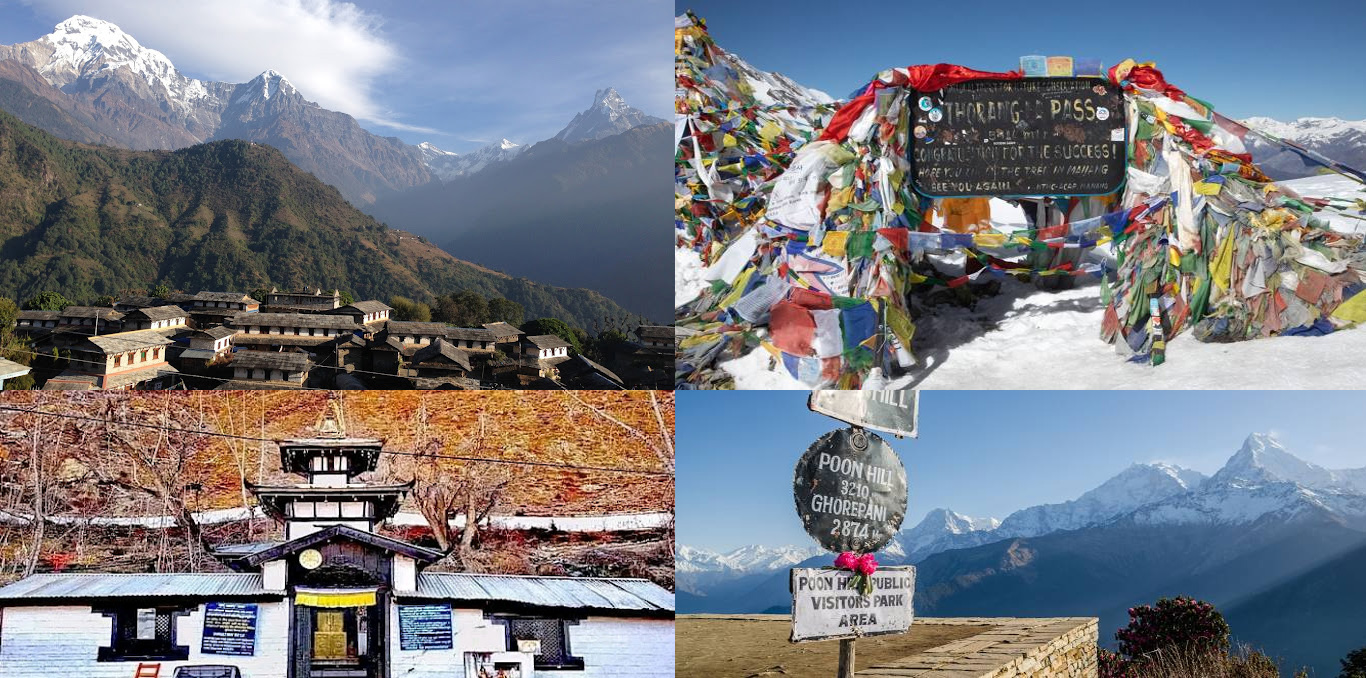
The highlight of the trek is crossing the legendary Thorong La Pass (5,416m), one of the highest trekking passes in the world. From the top, trekkers are rewarded with panoramic views of towering peaks including Annapurna, Dhaulagiri, and Manaslu ranges—an unforgettable achievement that defines this adventure.
Culture, Nature & Adventure Combined
What makes the Annapurna Circuit truly unique is its incredible variety. In just one journey, you experience lush green hills, cascading waterfalls, sacred pilgrimage sites like Muktinath Temple, and the dramatic landscapes of the Kali Gandaki Gorge—the world’s deepest gorge. The trek is not only physically rewarding but also culturally enriching, with opportunities to interact with locals, visit monasteries, and enjoy warm Himalayan hospitality in traditional teahouses.
Explore More Iconic Treks in Nepal
While the Annapurna Circuit is a complete adventure on its own, Nepal offers a wide range of equally spectacular trekking experiences. For those dreaming of standing at the base of the world’s highest mountain, the Classic Everest Base Camp trek is a legendary journey through the Khumbu region, offering close-up views of Mount Everest and Sherpa culture.
If you prefer a quieter and less crowded trail, the Manaslu region provides an off-the-beaten-path experience with the remote and scenic Manaslu Circuit Trek, rich in Tibetan culture and pristine landscapes. Likewise, the peaceful Langtang Valley Trek is perfect for those seeking a shorter yet rewarding Himalayan adventure near Kathmandu, combining stunning mountain views with Tamang heritage.
Other popular options include the Annapurna Base Camp Trek for a shorter route into the Annapurna Sanctuary, the Mardi Himal Trek for panoramic ridge-line views, and many more hidden gems waiting to be explored.
"Start your Himalayan journey today and discover why Nepal is a paradise for trekkers around the world."
Why Choose the 20-Day Annapurna Circuit Trek?
The Annapurna Circuit Trek is more than just a trekking route—it’s a journey through changing landscapes, cultures, and emotions. From the thrill of high-altitude passes to the serenity of mountain villages, every day offers something new and inspiring. With expert planning, proper acclimatization, and professional guidance from Mountain Mart Treks, this trek ensures both safety and an unforgettable experience.
While shorter versions of this trek exist, the 20-day "Classic" route remains the gold standard. It allows your body to adapt to the altitude gradually, significantly increasing your success rate for the formidable Thorong La Pass (5,416m).
By choosing Mountain Mart Treks, you are partnering with local experts who prioritize safety, sustainable tourism, and an authentic "teahouse" experience.
Key Highlights of the Journey:
-
Conquering Thorong La Pass: Stand at 5,416 meters and witness a 360-degree panorama of the Annapurna and Dhaulagiri ranges.
-
The World’s Deepest Gorge: Walk alongside the Kali Gandaki River, carved between two 8,000-meter giants.
-
Spiritual Awakening at Muktinath: Visit the sacred 108 water sprouts of this holy pilgrimage site for Hindus and Buddhists.
-
Sunrise at Poon Hill: Watch the first golden rays of sun hit the Macchapuchhre (Fishtail) and Annapurna South.
-
Cultural Immersion: Experience the hospitality of the Gurung, Magar, and Thakali communities.
Best Season for Annapurna Circuit Trekking in Nepal
Timing is everything. To witness the Himalayas in their full glory, we recommend booking during the two primary trekking seasons:
1. Spring (March to May): The trails are alive with blooming rhododendrons, and the weather is pleasantly warm at lower elevations.
2. Autumn (September to November): This is the peak season. Expect crystal-clear skies, stable weather, and the most iconic mountain views.
Why trek the 20-day Circuit with Mountain Mart Treks?
-
Optimal Acclimatization: We include extra nights in Ngawal and Manang to ensure you cross the 5,416m pass with confidence.
-
Diverse Scenery: Unlike shorter routes, this 20-day journey covers the entire loop, including the hot springs of Tatopani and the famous sunrise at Poon Hill.
-
Logistical Excellence: From private transfers to hand-picked tea houses, we handle the details so you can focus on the mountains.
Ready to start your journey? Book your Annapurna Circuit Trek 2026 season now for the best peak-season availability!
Annapurna Circuit Trek Itinerary
At Mountain Mart Treks & Expedition, we believe the journey is as important as the destination. Here is a snapshot of your 20-day adventure:
Day 01: Arrive in Kathmandu (1,300m) – Welcome to Nepal
Upon arrival, MMT staff will welcome you at the airport and transfer you to your hotel. Trek briefing and rest.
Day 02: Kathmandu Valley Sightseeing & Preparation
Explore UNESCO World Heritage Sites and complete final preparations for your trek.
Day 03: Kathmandu to Jagat (1,300m) – Scenic Drive
Enjoy a long but scenic drive through rivers, hills, and rural landscapes to reach Jagat.
Day 04: Jagat to Dharapani (1,860m) – Entering Annapurna Region
Trek through beautiful villages and forests as you officially enter the Annapurna Region.
Day 05: Dharapani to Chame (2,670m) – Mountain Views Begin
Walk through pine forests with stunning views of Lamjung Himal and Annapurna II.
Day 06: Chame to Pisang (3,300m) – Alpine Landscape
Trek through narrow valleys and enjoy dramatic changes in scenery and altitude.
Day 07: Pisang to Ngawal (3,660m) – High Route Adventure
Take the upper trail for better views and gradual acclimatization.
Day 08: Ngawal to Manang (3,540m) – Cultural Exploration
Descend slightly to Manang, a culturally rich village with Tibetan influence.
Day 09: Manang – Acclimatization Day
Rest and explore nearby viewpoints to adjust to higher altitude.
Day 10: Manang to Yak Kharka (4,050m) – Into High Altitude
Gradual ascent into alpine terrain with fewer trees and more open landscapes.
Day 11: Yak Kharka to Thorong Phedi (4,525m) – Base of the Pass
Short trek to prepare for crossing the high mountain pass.
Day 12: Thorong Phedi to Muktinath Temple via Thorong La Pass (5,416m)
The most challenging and rewarding day crossing Thorong La Pass, then descend to Muktinath.
Day 13: Muktinath to Tatopani (1,190m) – Relaxation Day
Drive down to Tatopani and enjoy natural hot springs to relax your body.
Day 14: Tatopani to Ghorepani (2,860m) – Forest & Village Trek
Trek through lush forests and charming villages to reach Ghorepani.
Day 15: Ghorepani – Poon Hill – Tadapani (2,630m)
Early morning hike to Poon Hill for sunrise, then trek to Tadapani.
Day 16: Tadapani to Ghandruk (1,940m) – Cultural Village
Descend to a traditional Gurung village with stunning mountain views.
Day 17: Ghandruk to Pothana (1,990m) – Scenic Trail
Trek through forests and peaceful landscapes toward Pothana.
Day 18: Pothana to Phedi – Drive to Pokhara (820m)
Short trek to Phedi followed by a drive to Pokhara for relaxation.
Day 19: Pokhara to Kathmandu (1,300m) – Return Journey
Drive or fly back to Kathmandu with beautiful memories.
Day 20: Final Departure
Transfer to the airport for your onward journey. Farewell and see you again!
Attractions of the Annapurna Circuit Trek
Here are the main attractions of the Annapurna Circuit Trek:
- Thorong La Pass – Breathtaking Himalayan views at 5,416 m.
- Annapurna & Dhaulagiri Ranges – Iconic snow-capped peaks.
- Manang & Ghasa Villages – Traditional Gurung and Thakali culture.
- Muktinath Temple – Sacred site for Hindus and Buddhists.
- Tatopani Hot Springs – Relax in natural thermal waters.
- Kali Gandaki & Marsyangdi Valleys – Deep gorges and scenic landscapes.
- Ghorepani & Poon Hill – Famous viewpoint for sunrise over Annapurna and Dhaulagiri.
- Rhododendron Forests & Wildlife – Trek through vibrant flora and rare animals.
- Tilicho Lake (Optional) – High-altitude alpine lake with stunning views.
Annapurna Circuit Trek Permits
| Permit Name |
Purpose |
Cost (Approx.) |
Where to Obtain |
Documents Required |
Validity |
Remarks |
| Annapurna Conservation Area Permit (ACAP) |
Required to enter and trek within the Annapurna Conservation Area |
NPR 3,000 (Foreigners)
NPR 1,000 (SAARC) |
Nepal Tourism Board Office in Kathmandu or Pokhara |
Passport copy, 2 passport-size photos |
Single Entry |
Mandatory for all trekkers entering the Annapurna region |
| TIMS Card (Trekkers’ Information Management System) |
Ensures trekker safety and route tracking |
NPR 2,000 (FIT)
NPR 1,000 (Group trekkers) |
Trekking Agencies' Association of Nepal Office in Kathmandu or Pokhara |
Passport copy, photos, travel details |
Single Entry |
Required for monitoring trekkers and emergency assistance |
Preparing for Your Adventure: Expert Tips for Annapurna Circuit Trek
Proper preparation is the key to a safe, enjoyable, and successful journey in the Himalayas. Whether you are trekking in the breathtaking Annapurna Region or aiming to cross high-altitude passes like Thorong La Pass, being well-prepared will enhance your overall experience.
Physical Fitness & Training
You don’t need to be an elite athlete, but a good level of fitness is essential for the Annapurna Circuit Trek. This adventure involves walking 5–7 hours daily at varying altitudes. We recommend starting your preparation at least 3–4 months in advance with activities like hiking, cycling, swimming, and cardio workouts. Building stamina and leg strength will help you enjoy the trek comfortably and reduce fatigue at higher elevations.
What to Pack – Essential Gear
Packing smart is crucial for a comfortable trekking experience in Nepal. Here are the key essentials:
- High-quality down jacket (for cold himalyan temperatures)
- -10°C rated sleeping bag (available from Mountain Mart Treks if required)
- Well broken-in trekking boots (avoid brand-new shoes to prevent blisters)
- Water purification tablets or filtered bottle (safe drinking water is essential)
- Warm layers, gloves, hat, and sunglasses
- Lightweight backpack with daily essentials
Proper gear ensures you stay warm, safe, and comfortable throughout your journey.
Safety First – Your Wellbeing Matters
Your safety is our top priority. Our professional guides are trained in Wilderness First Aid and have extensive experience in high-altitude trekking. They carry essential medical kits and use pulse oximeters to monitor your oxygen saturation levels daily, helping prevent altitude-related issues.
We follow a carefully designed itinerary with proper acclimatization days to ensure a safe ascent. With Mountain Mart Treks & Expedition Pvt. Ltd., you can trek with confidence knowing you are in expert hands.
Final Tips for Annapurna Circuit Trek
Preparation is not just physical—it’s mental too. Stay positive, walk at your own pace, and enjoy every moment of this incredible Himalayan journey. With the right preparation and expert support, your Annapurna Circuit Trek will be a truly unforgettable adventure.
People and Culture on the Annapurna Circuit Trek
The Annapurna Circuit Trek is not just a journey through breathtaking landscapes—it’s a deep dive into Nepal’s rich cultural tapestry. Along the trail, trekkers pass through traditional villages inhabited by Gurung, Thakali, and Manangi communities, each with unique customs, festivals, and architecture. Monasteries, prayer wheels, and chortens (Buddhist shrines) punctuate the route, reflecting the strong Buddhist influence, while local markets and tea houses offer a glimpse into daily Himalayan life. This trek provides a rare opportunity to experience the harmony of nature and culture in one of the world’s most remote and vibrant regions.
Annapurna Circuit Trek Difficulty
The Annapurna Circuit Trek is considered moderate to challenging, suitable for trekkers with a reasonable level of fitness and some hiking experience. The trek spans diverse terrains—from lush lowland forests to rugged high-altitude passes—requiring stamina for long walking days of 5–8 hours. The most demanding part is crossing Thorong La Pass (5,416 m/17,769 ft), where altitude, steep ascents, and unpredictable weather test endurance. While well-supported with teahouses along the route, trekkers must be prepared for varying trail conditions, sudden temperature changes, and gradual altitude gain, making proper acclimatization, physical preparation, and mental resilience essential for a safe and enjoyable journey.
Annapurna Circuit Trek Challenges
The Annapurna Circuit Trek offers stunning views, but trekkers face several challenges along the way. High altitude is the main concern, especially at Thorong La Pass (5,416 m/17,769 ft), where altitude sickness can occur if proper acclimatization is ignored. Steep ascents and descents test physical endurance, while unpredictable weather, including rain, snow, or strong winds, can make trails slippery and difficult. Remote sections may have limited medical facilities, and long walking days can be physically exhausting. Additionally, carrying gear, navigating rocky or narrow paths, and coping with cold temperatures in higher regions add to the trek’s overall challenge. Proper preparation, fitness, and guidance from experienced local guides help overcome these hurdles safely.
Flora & Fauna on the Annapurna Circuit Trek
The Annapurna Circuit Trek passes through diverse ecosystems, showcasing Nepal’s rich flora and fauna. In the lower regions, subtropical forests are filled with bamboo, rhododendron, oak, and maple trees. As altitude increases, forests give way to alpine meadows dotted with wildflowers like primulas and blue poppies. The trek is home to wildlife such as Himalayan thar, langur monkeys, musk deer, and snow leopards in remote areas, while colorful birds like pheasants, eagles, and sunbirds add vibrancy to the trails. This blend of lush greenery, high-altitude flora, and rare wildlife makes the Annapurna Circuit a paradise for nature lovers and wildlife enthusiasts.
Annapurna Circuit Trek FAQs
1. What is the Annapurna Circuit Trek difficulty level?
The trek is moderate to challenging, suitable for fit beginners and experienced trekkers. High-altitude sections like Thorong La Pass require proper acclimatization.
2. How long does the Annapurna Circuit Trek take?
The full circuit typically takes 18-20 days, depending on your pace and side trips such as Tilicho Lake or Ghorepani Poon Hill.
3. What is the best season to trek the Annapurna Circuit?
The ideal seasons are spring (March–May) for rhododendron blooms and autumn (September–November) for clear mountain views.
4. Do I need a guide for the Annapurna Circuit Trek?
While optional for experienced trekkers, a licensed local guide is recommended for safety, navigation, and cultural insights.
5. What permits are required for the trek?
You need the Annapurna Conservation Area Permit (ACAP) and Trekkers’ Information Management System (TIMS) card to trek legally.
6. What kind of accommodation is available along the route?
Teahouses and lodges provide basic rooms with meals, hot showers in some places, and a chance to experience local hospitality.
7. What are the main attractions of the Annapurna Circuit Trek?
Highlights include Thorong La Pass, Annapurna & Dhaulagiri views, Ghorepani Poon Hill, Muktinath Temple, Tatopani Hot Springs, Kali Gandaki Valley, Rhododendron forests, and Tilicho Lake.
8. How physically fit do I need to be for the trek?
Moderate fitness is sufficient, but cardio training, long hikes, and stair climbing before the trek help significantly.\
9. Is altitude sickness a concern on the Annapurna Circuit?
Yes, especially at Thorong La Pass (5,416 m). Gradual ascent, proper acclimatization, and staying hydrated reduce risks.
10. What kind of food is available during the trek?
Local teahouses serve Dal Bhat, noodles, soups, eggs, and snacks. Vegetarian and vegan options are widely available.
11. Can I trek the Annapurna Circuit independently?
Yes, but trekking with a guide or porter is safer, helps with navigation, local culture, and carrying heavy gear.
12. What wildlife and nature can I expect on the trek?
The route features rhododendron forests, alpine meadows, Himalayan thar, langurs, pheasants, and snow leopards in remote areas.
13. What is the best way to reach the start of the trek?
Most trekkers fly or drive to Besisahar or Pokhara, which are the common starting points for the circuit.
Book Your Annapurna Adventure Today
The mountains are calling. Are you ready to answer?
Mountain Mart Treks & Expedition Pvt. Ltd. is proud to be a leading trekking agency in Nepal, known for our personalized service and deep-rooted local knowledge. Join us for the Annapurna Circuit Trek 20 Days and create memories that will last a lifetime.
👉 [Contact Us to Reserve Your Spot for the Upcoming Season] Website: www.mountainmarttreks.com
Email: info@mountainmarttreks.com